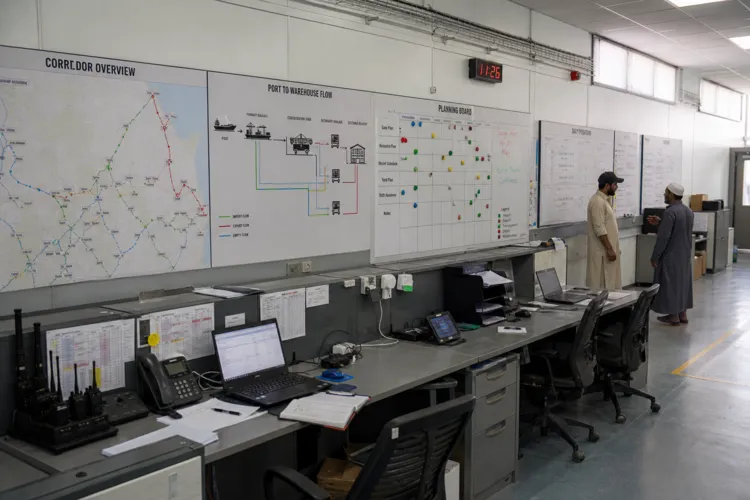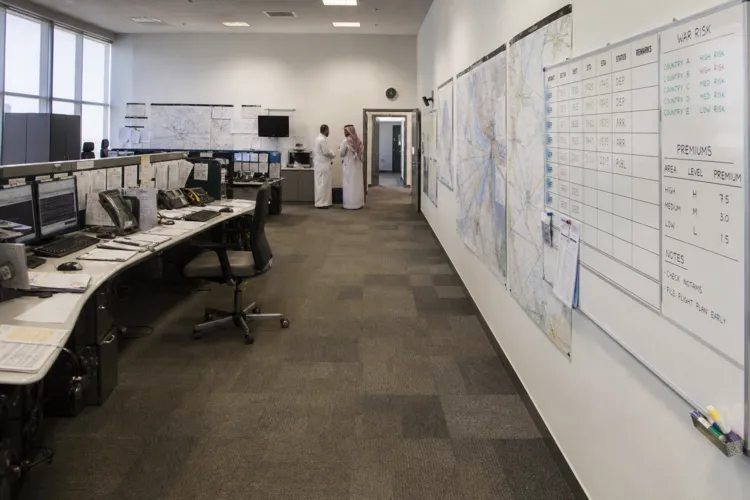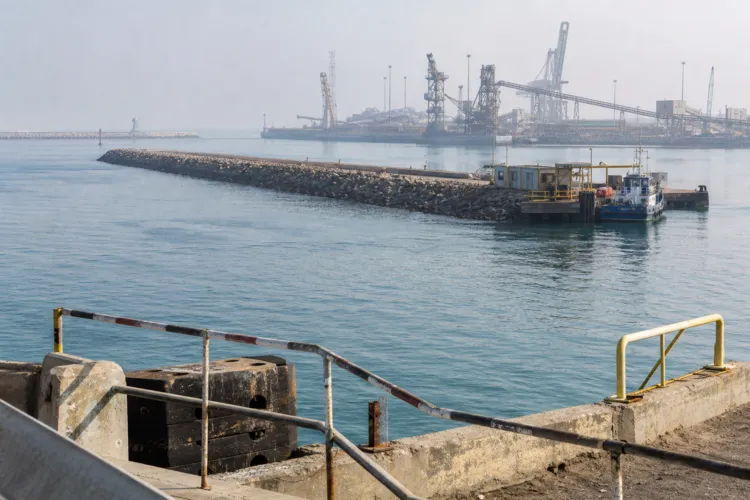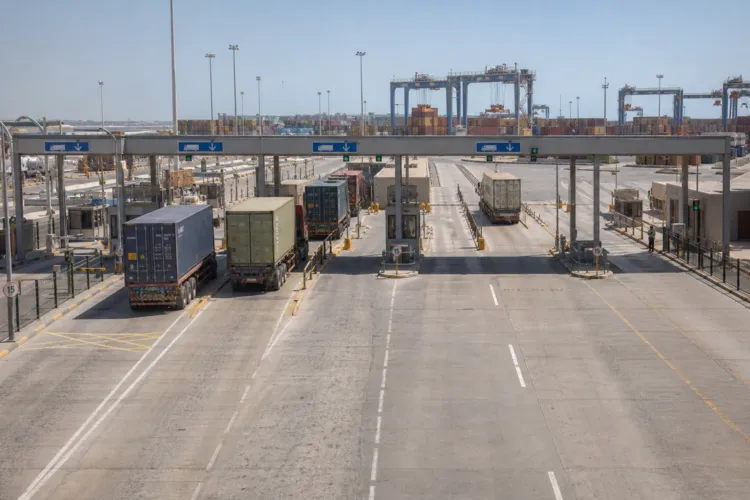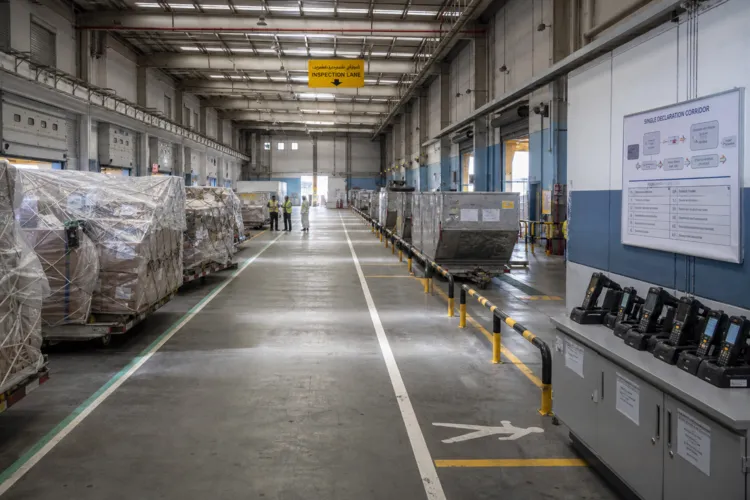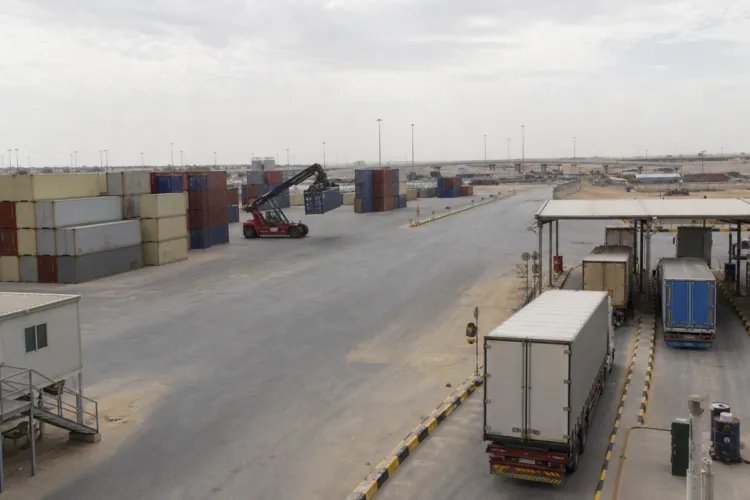
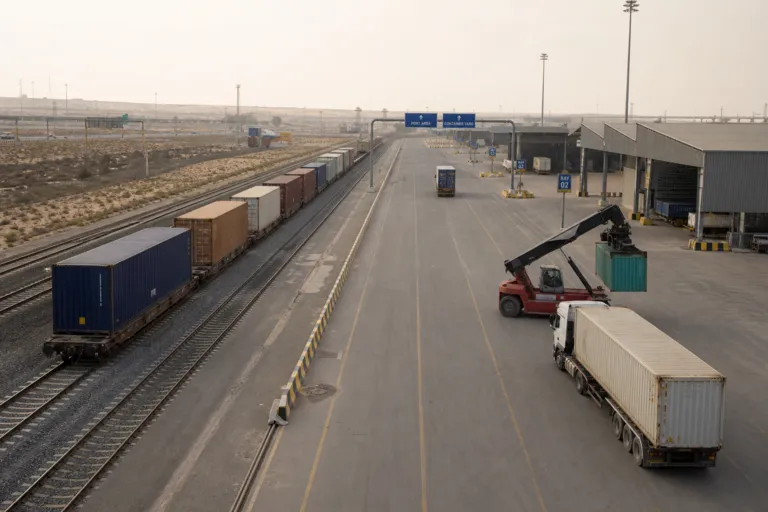
Repeated disruption around key waterways has made “portfolio of corridors” thinking more practical than theoretical in the Gulf. In that context, the Saudi-Egypt route to the Mediterranean is being framed as a Hormuz-proof option for non-energy freight. Seatrade Maritime reports that Saudi Arabia and Egypt are working on a new logistics corridor between Arabian Gulf countries, the Red Sea, Egypt, and the Mediterranean, intended to bypass the Strait of Hormuz and move millions of tonnes of non-energy cargo via a landbridge. The corridor logic is straightforward: shift cargo onto a connected chain of rail, road, ferries, and ports, so the supply chain is less dependent on one maritime chokepoint.
On the Saudi side, the planned Saudi Landbridge Project under Vision 2030 is designed as an east-west freight rail corridor connecting Arabian Gulf ports with Red Sea gateways through Riyadh. Vision2030.ai describes Saudi Arabia spanning approximately 1,200 kilometres from the Arabian Gulf to the Red Sea, and positions a high-capacity rail link as an alternative routing to Suez-dependent maritime patterns for some trades. The preferred alignment generally runs from the Dammam-Jubail port zone through Riyadh and westward to Jeddah, with total route length estimated at approximately 1,000 to 1,300 kilometres depending on final alignment. Technical options under consideration include standard-gauge track capable of supporting double-stack container operations, heavy-haul freight, and electrification.
How the Gulf-to-Egypt Chain Connects to Mediterranean Terminals
Reporting on the landbridge concept adds the Egyptian and Red Sea legs that turn a national rail plan into a cross-border routing. Seatrade outlines a flow in which cargo links Gulf nations via rail across Saudi Arabia to Red Sea ports including Jeddah Islamic Port, King Abdullah Port, and the Port of Neom. Cargo would then ship across the Red Sea to Sokhna and Safaga, and continue by rail to Egypt’s Mediterranean coast port of Damietta. Port capacity and readiness matter for scale: Seatrade notes the 93-hectare Damietta Alliance Container Terminals (DACT) began operations in February as a 3.3m TEU facility, able to handle container ships of up to about 20,000 TEU with 25 rows across deck, with chart datum depth of -18m.
Early operating patterns show how quickly non-oil logistics can adapt when maritime access tightens. EnterpriseAM reports UAE-based trucking platform Trukker deployed more than 500 trucks during early conflict conditions and recorded a 30% increase in road shipments during March. It also describes a functioning Europe-Egypt-GCC corridor in which trailers arrived at Damietta, moved overland to Safaga, crossed by ferry to Neom, and then continued by road into Gulf markets. The New Arab similarly reports that hundreds of tonnes of refrigerated and dry cargo have been pouring into Damietta from Europe for several weeks, especially from Italy’s Trieste port, before moving onward toward Safaga and then to Gulf markets via Saudi Red Sea ports such as Duba.
In parallel, longer-term rail and corridor plans anchor today’s trucking-and-ferry workarounds into future infrastructure. Strategy International says Egypt is developing seven integrated logistics corridors by 2030, upgrading road and rail links between Ain Sokhna, Alexandria, Damietta, Safaga, inland industrial and mining regions, and border crossings, with the aim of capturing Gulf flows being rerouted toward the Red Sea and Mediterranean. The same source notes a 1,700 km freight corridor to the Jordan border designed to shift freight between Red Sea and Gulf coasts. Seatrade adds that the landbridge is expected to link with the 2,117-kilometre GCC Railway project due for completion in 2030, including a high-speed 785-kilometre track linking Riyadh and Doha. Together, these building blocks define the Saudi Egypt logistics corridor Mediterranean concept as a multi-node system, not a single rail line.
What is the Saudi-Egypt logistics route designed to achieve between the Gulf and the Mediterranean?
Which ports are named as key nodes in the Saudi and Egyptian legs of the corridor?
What route length is cited for Saudi Arabia’s planned Landbridge rail corridor?
What container terminal details are reported for Damietta that support Mediterranean throughput?
What evidence suggests landbridge trucking scaled up during disruption?