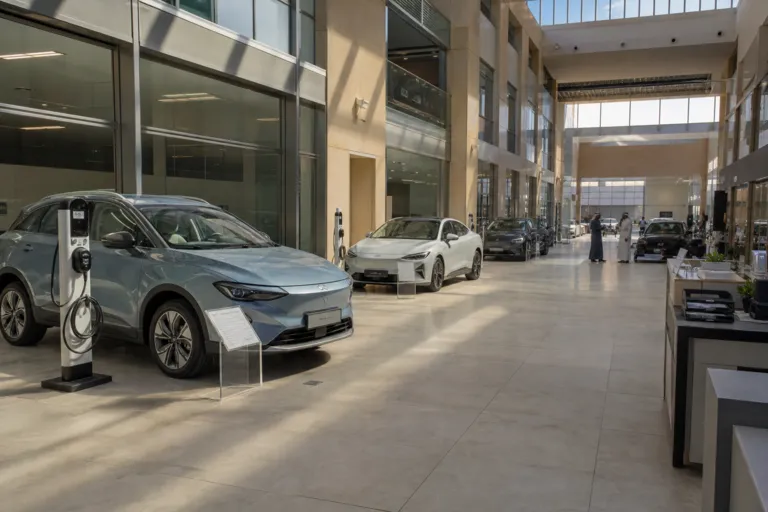
Saudi Arabia’s auto market in 2026 is in a reset phase, yet the competitive balance inside that slowdown is changing. Focus2move reports total sales down 20.3% year to date through July 2026, alongside a clear theme: Chinese brands are increasingly gaining share while traditional leaders decline. Inside this broader picture, electrification is present but still emerging. EVs account for 4.8% of total industry sales in 2026, and EV sales are reported to be up 3.0% year on year. The result is a market where EVs remain small, but brand momentum is already moving.
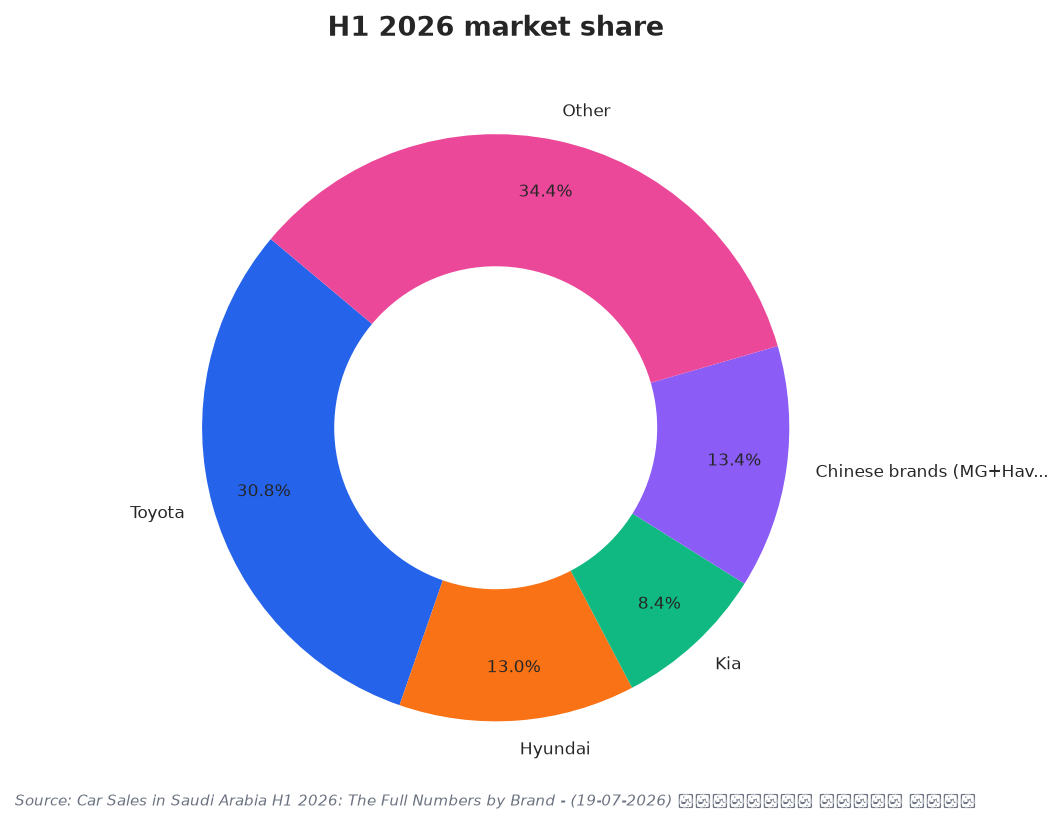
In the first half of 2026, brand-level results show how far Chinese makers have pushed into the mainstream. Autopunditz and HalaCarly both put H1 2026 Saudi new vehicle sales at around 410,000 units, up 6.2% year on year. Toyota led with 126,300 vehicles and a 30.8% share, followed by Hyundai with 53,300 (13%) and Kia with 34,400 (8.4%). Yet the headline structural shift is lower down the list: four Chinese brands—MG, Haval, Jetour, and Changan—entered the top ten with a combined 13.4% market share, giving China a larger presence in everyday buying decisions, not just niche demand.
Where the Chinese Advance Meets Early-Stage EV Adoption
EV uptake is growing, but it is not yet rewriting the whole market on its own. Focus2move describes electrification as “significantly less mature,” with EVs at 4.8% share and growth in 2026 characterized as gradual rather than exponential. Even so, EV momentum can still reshape brand perceptions quickly when it is concentrated. Focus2move calls BYD the standout EV performer in Saudi Arabia, reporting sales increasing by 368.6%. That surge matters because it links the broader Chinese brand rise to the emerging EV segment, signalling how model availability and locally relevant product choices can pull demand forward as the market develops.
Monthly data adds texture to why Chinese brands are gaining share during a tougher cycle. ArabWheels reports April 2026 light-vehicle sales fell 21.9% year on year to 50,993 units, while year-to-date volume fell 23.8% to 217,741 units. Even in that contraction, multiple Chinese brands grew: MG rose 41.5%, Haval gained 30.7%, Jetour climbed 29.7%, and Changan advanced 22.4%. ArabWheels also notes MG’s April share at 4.4% versus 2.7% year to date, pointing to momentum that stands out even when overall demand weakens.
Looking beyond the showroom, several signals point to why the Saudi EV story remains a long game while competition intensifies now. CITA cites a Saudi EV market valuation of SAR 3.2 billion in 2024, up from SAR 2.5 billion in 2023, and describes a 35% CAGR with a projection to SAR 18 billion by 2030. The same source highlights a CEER Electric Vehicles joint venture between PIF and Foxconn, with SAR 16.5 billion investment and planned production capacity of 175,000 vehicles annually, and reports research indicating 65% of Saudi consumers plan to purchase an EV by 2026. Put together, the Saudi EV market share in 2026 may still look small, but Chinese brands already have a widening platform to compete as electrification builds.
What is the EV share of total vehicle sales in Saudi Arabia in 2026?
Which Chinese brands are already in Saudi Arabia’s top 10 by sales in H1 2026?
What does the Saudi EV market share in 2026 suggest about Chinese brands’ opportunity?
How did Chinese brands perform during the April 2026 market decline?
What Saudi EV growth and investment signals are cited for the coming years?