Jeddah FIR is carrying more strategic weight as airlines look for workable paths between Europe and Asia. OPSGROUP describes two “real options” for Europe–Asia traffic: north via the Caucasus then Afghanistan, or south via Egypt then Saudi Arabia then Oman. At the same time, Kuwait remains closed to overflights, currently until Nov 2, leaving “no direct central route through the region.” That forces more flows into the southern corridor and concentrates demand in and around Saudi-controlled airspace, even while operators manage dynamic security and operational constraints.
The security overlay is not theoretical. EASA issued a dedicated conflict zone information bulletin (CZIB) for parts of the Jeddah FIR, stating the regional security situation is “highly volatile,” with significant kinetic activity affecting Saudi airspace. EASA also cites recurrent missile and drone attacks and notes risks from air-defence activations, including misidentification, interception activity, and falling debris. OPSGROUP further notes that GPS jamming and spoofing remain widespread across the region. In practical terms, this means the same airspace that functions as a regional bypass must also support close monitoring, tactical deconfliction, and contingency planning.
Peak Demand Meets Constrained Infrastructure in the West
On the demand side, the airport system is already absorbing large volumes. Travel And Tour World reports Saudi Arabia’s airports handled 140.9 million passengers in 2025, with Jeddah, Riyadh, and Dammam driving aviation growth. But the most immediate choke point is on the Red Sea gateway itself: a 2026 guide to King Abdulaziz International Airport (Jeddah) says Saudi authorities acknowledge current infrastructure is running at roughly 107% of designed capacity. When a busy airport sits under a heavily used overflight corridor, delays and variability can cascade quickly—especially during peak periods when Jeddah’s role as a pilgrimage gateway intensifies operational pressure.
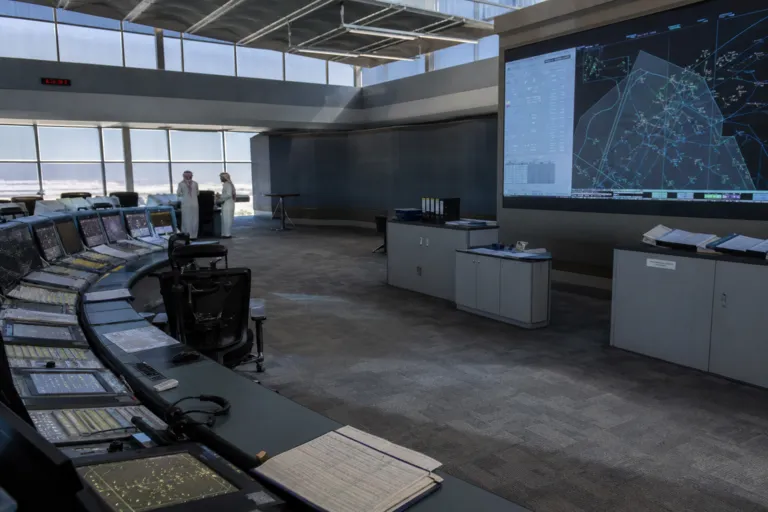
Looking ahead, the scale of planned growth implies that Saudi air navigation services and airspace capacity planning cannot be treated as a secondary workstream. Spherical Insights describes an approximately $100 billion government and private-sector aviation investment push under Vision 2030. It cites targets of 330 million annual passengers by 2030, connectivity to more than 250 destinations, and 4.5 million tonnes of annual air-cargo capacity. The same source lists “air-traffic systems” and “digital systems” among the investment areas. If network growth is meant to be smooth, then the enabling layer—controllers, procedures, surveillance and flow tools—must expand alongside terminals, runways, and fleets.
The operational picture shows why the investment case is urgent rather than optional. EASA notes Saudi Arabia has demonstrated an ability to manage its airspace effectively, including through tactical deconfliction and Emergency Security Control of Air Traffic (ESCAT) measures, yet it also warns the environment remains vulnerable to rapid deterioration. Meanwhile, the southern bypass role is reinforced by constraints elsewhere: OPSGROUP highlights that the main Europe–Asia routes remain south via Egypt–Saudi–Oman/UAE or north via the Caucasus–Afghanistan. Keeping Jeddah FIR reliable at peak demand therefore depends on strengthening capacity and resilience together, so reroutes, alerts, and disruptions do not overload the system.
Why has Jeddah FIR become a southern bypass for Europe–Asia flights?
What does EASA warn about in parts of the Jeddah FIR?
What evidence shows capacity stress around Jeddah?
How does the Vision 2030 aviation plan connect to Saudi air navigation services airspace capacity needs?