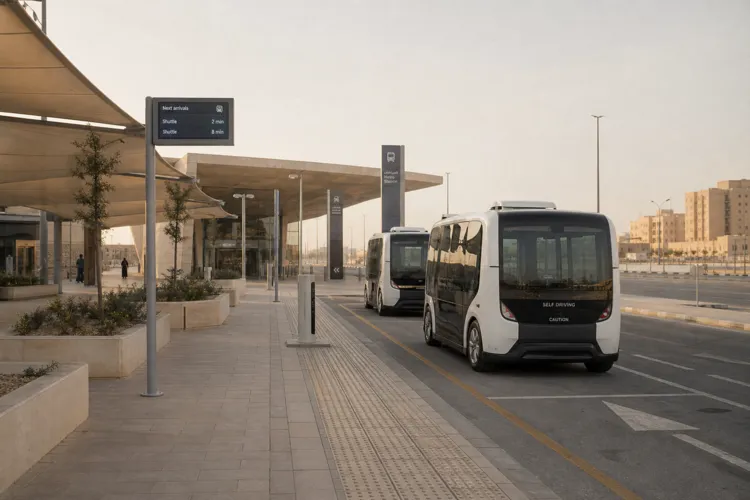
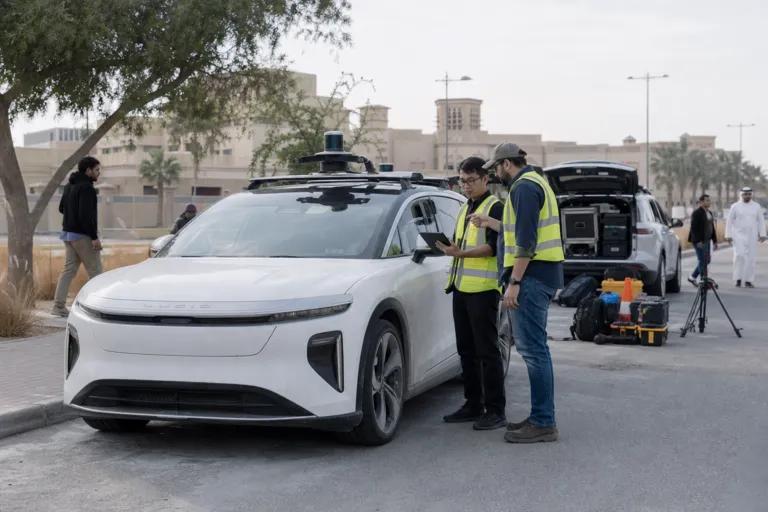
Uber, Lucid Group, and Nuro are positioning a new robotaxi program as a global effort, with a vehicle purpose-built for Uber’s ride-hailing network. The plan centers on Lucid Gravity SUVs equipped with Nuro Driver autonomous driving technology, which Uber says would be purchased and operated by Uber or its third-party partners. Public reporting states Uber aims to launch the first vehicle later in 2026 in an unidentified major U.S. city, and that the company plans to deploy at least 20,000 robotaxis over six years. That timeline is important context for any discussion about future expansion, because the first announced launch details are explicitly tied to the U.S., not Saudi Arabia.
The partners provided a clearer look at the project at CES 2026, where they unveiled production-intent vehicles and showed an Uber-designed in-cabin rider experience. Lucid’s leadership described the Gravity platform’s engineering, range, and interior comfort as a base for the service, while emphasizing the combination of Lucid’s EV capabilities, Nuro’s autonomy, and Uber’s scale. The same CES coverage also noted that on-road testing had begun in the San Francisco Bay Area, and that this testing started in December under Nuro’s lead, supervised by autonomous vehicle operators. The companies described the testing program as spanning on-road work, closed-course testing, and simulation to validate performance across many scenarios.
Where Saudi Arabia Fits in the Story—and What’s Confirmed
Saudi Arabia appears in the public narrative mainly through adjacent partnerships and investment context, rather than a confirmed launch plan. One report notes Lucid partnered earlier in the year with King Abdullah University of Science and Technology in Saudi Arabia, as Lucid continues to work on its own autonomous and driver-assistance technology alongside this robotaxi program. Separately, analysis commentary highlights that Saudi Arabia’s Public Investment Fund (PIF) is a major investor in both Lucid and Uber, and suggests the fund could facilitate strategic moves that help each company. However, none of the cited launch milestones explicitly confirm a Saudi deployment date or city, so any Saudi-road implications should be framed as potential rather than announced.
Commercially, the partnership has also been described with a specific investment milestone. WardsAuto reports that in September 2025 Lucid closed on a $300 million investment from Uber, tied to adding up to 20,000 Gravity robotaxis to Uber’s ride-hailing platform over the next six years in “dozens of global markets.” Production is expected to begin later in the year at Lucid’s factory in Casa Grande, Arizona, pending validation of the final design. This “global markets” language is one of the few explicit signals that the program is not intended to remain U.S.-only, even though the initial launch and testing references focus on the San Francisco Bay Area and an unidentified major U.S. city.
For readers tracking a Lucid Nuro Uber robotaxi Saudi Arabia angle, the most grounded takeaway is the structure and momentum of the program, not a Saudi rollout promise. Uber has announced more than a dozen autonomous partnerships, including relationships with Waymo and Volkswagen Group of America, as it aims to be a major commercial app for robotaxis. The Lucid-Nuro-Uber program adds a new vehicle and autonomy stack to that strategy, while Nuro’s own history shows a focus shift: it partnered with Uber in 2022 on food delivery robots, then pivoted the following year from building custom autonomous vehicles to concentrating on autonomous software. Together, these details explain why Uber is building optionality across partners—and why Saudi Arabia may be part of the long-term “global” footprint even if it is not yet named.
What is Uber’s stated deployment plan for the Lucid and Nuro robotaxi program?
Where has on-road testing been reported for the robotaxi prototypes?
Is Saudi Arabia confirmed as a launch market for the Lucid-Nuro-Uber robotaxi?
How does the Lucid Nuro Uber robotaxi story connect to Saudi Arabia today?