Saudi autonomous vehicle regulation 2026 is being shaped in a world where lawmakers are trying to decide who pays when “no one is driving.” A study highlighted by Devdiscourse frames the core dilemma plainly: liability may point to a human owner, a manufacturer, or the autonomous system itself. It also notes the internationally recognized six levels of automation, from Level 0 to Level 5, and stresses that Levels 2 or 3 still require human oversight while Levels 4 and 5 can make human intervention optional or even impossible. That shift makes traditional “driver liability” harder to apply when decisions depend on complex algorithms.
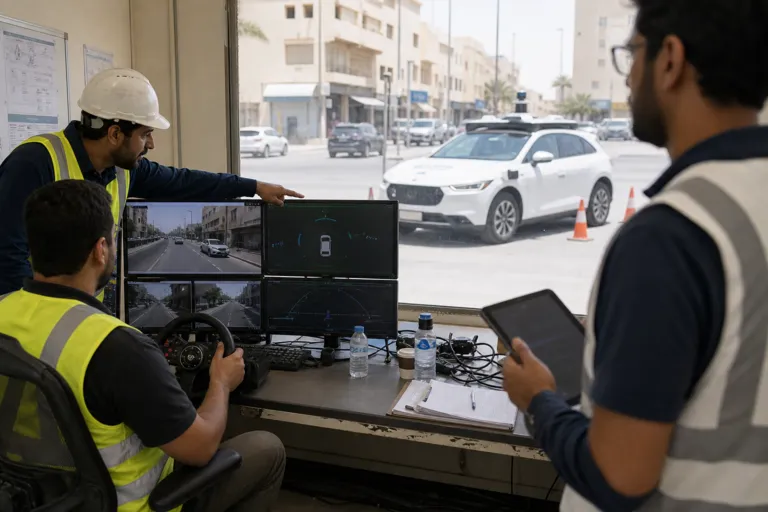
In Saudi Arabia, the liability question is no longer abstract. A July 2025 report says the Kingdom launched its first self-driving vehicle trial in Riyadh under Vision 2030. The pilot is described as a cross-government collaboration involving the Ministry of Interior, SDAIA, the General Authority for Survey and Geospatial Information, and the Saudi Standards, Metrology and Quality Organisation. The vehicles are being tested in real-world environments, including King Khalid International Airport, key highways, and selected areas in central Riyadh. Each vehicle carries a safety operator on board, while performance is closely monitored by the Public Transport Authority. That “operator onboard” detail matters because it creates a practical handoff point for liability.
Why Liability Is Being Rewritten Around the “Handoff”
One U.S.-focused analysis in The National Law Review explains why Level 3 driving can create “murky handoff scenarios.” If the system issues a takeover request too late or the human fails to respond, both the manufacturer and the “driver” may face exposure. The same source notes some automakers have retreated from Level 3 precisely because of this liability risk. For Saudi autonomous vehicle regulation 2026, this is a warning sign: even with a safety operator onboard, rules must specify when the operator is treated as the responsible party, when the developer is, and what evidence resolves that dispute after a crash or violation.
Meanwhile, the U.S. Congress is pushing safety-process rules without rewriting tort liability. The National Law Review describes the SELF DRIVE Act of 2026 (H.R. 7390) as introduced on Feb. 5, 2026, and advanced through subcommittee on a party-line vote of 12 to 11. It would strengthen NHTSA authority, require manufacturers to submit detailed “safety cases,” and update FMVSS for driverless designs, while preempting conflicting state manufacturing bans. But it would not create new liability rules or shield compliant manufacturers from common-law suits. Another report on the House discussion draft similarly emphasizes safety cases, cybersecurity planning requirements, and NHTSA testing, evaluation, and compliance processes.
Critics argue that how a country structures authority can affect a victim’s path to compensation. Autoweek quotes Center for Auto Safety executive director Michael Brooks warning that a pre-emption clause “would act to ensure that local authorities are powerless to protect citizens while weakening those citizens’ ability to pursue effective claims.” At the state level, States Newsroom reporting says lawmakers in 25 states introduced 67 bills related to autonomous vehicles, and that between 2021 and 2024 there were 696 accidents reported involving a Waymo vehicle, according to an analysis by DiMarco | Araujo | Montevideo. California has also moved toward enforcement tools, with its DMV rules allowing law enforcement to issue a Notice of AV Noncompliance when vehicles commit a moving violation.
China shows a different model that explicitly centers liability on the operator first. CleanTechnica reports that when a Level-4 or Level-5 vehicle is operating in autonomous mode, the human occupant is not considered the driver, and compensation liability “shall first” be borne by the operator, with recovery actions possible afterward. The same source adds that Beijing requires both manufacturers and operators to carry mandatory traffic-accident liability insurance, carrier liability insurance, and additional commercial coverage, with Shanghai imposing similar insurance obligations. For Saudi autonomous vehicle regulation 2026, the emerging lesson is that clear role definitions, operator accountability, and structured compensation pathways can reduce uncertainty created by the safety-operator model used in Riyadh trials.
What does Saudi autonomous vehicle regulation 2026 need to clarify most?
Does the U.S. SELF DRIVE Act of 2026 create new liability protections for manufacturers?
What is a “safety case” in the 2026 U.S. proposal?
How does China assign liability when a Level-4 or Level-5 vehicle is in autonomous mode?
Where is Saudi Arabia testing self-driving vehicles, and who monitors them?