Saudi Arabian Railways (SAR) has issued a tender for design consultancy services for the Kingdom’s 672km section of the GCC rail network. Multiple sources describe this Saudi section as part of a wider regional corridor that links the six Gulf Cooperation Council member states, with overall length stated as 2,177km by International Railway Journal and Wikipedia, and 2,186km by MEP Middle East and Zawya. The tender is positioned as a step to advance the cross-border rail link between Kuwait and the UAE border, and it places design scope—rather than construction—at the center of the next procurement stage.
Across reports, the scope is consistent: the consultancy covers concept design, preliminary design, and Issued for Construction (IFC) design. International Railway Journal adds a key requirement for the selected contractor: review, update, and complete existing preliminary designs. Construction Review Online also reports that SAR issued the tender on 7 May, with bid submissions due by 30 June. Route endpoints are described as starting at Al-Khafji in Saudi Arabia’s Eastern Province near the Kuwait border and ending at Al-Batha on Saudi Arabia’s border with the UAE, framing the design work around border-to-border integration rather than an isolated domestic segment.
How the GCC Route Split Shapes the Bid Landscape
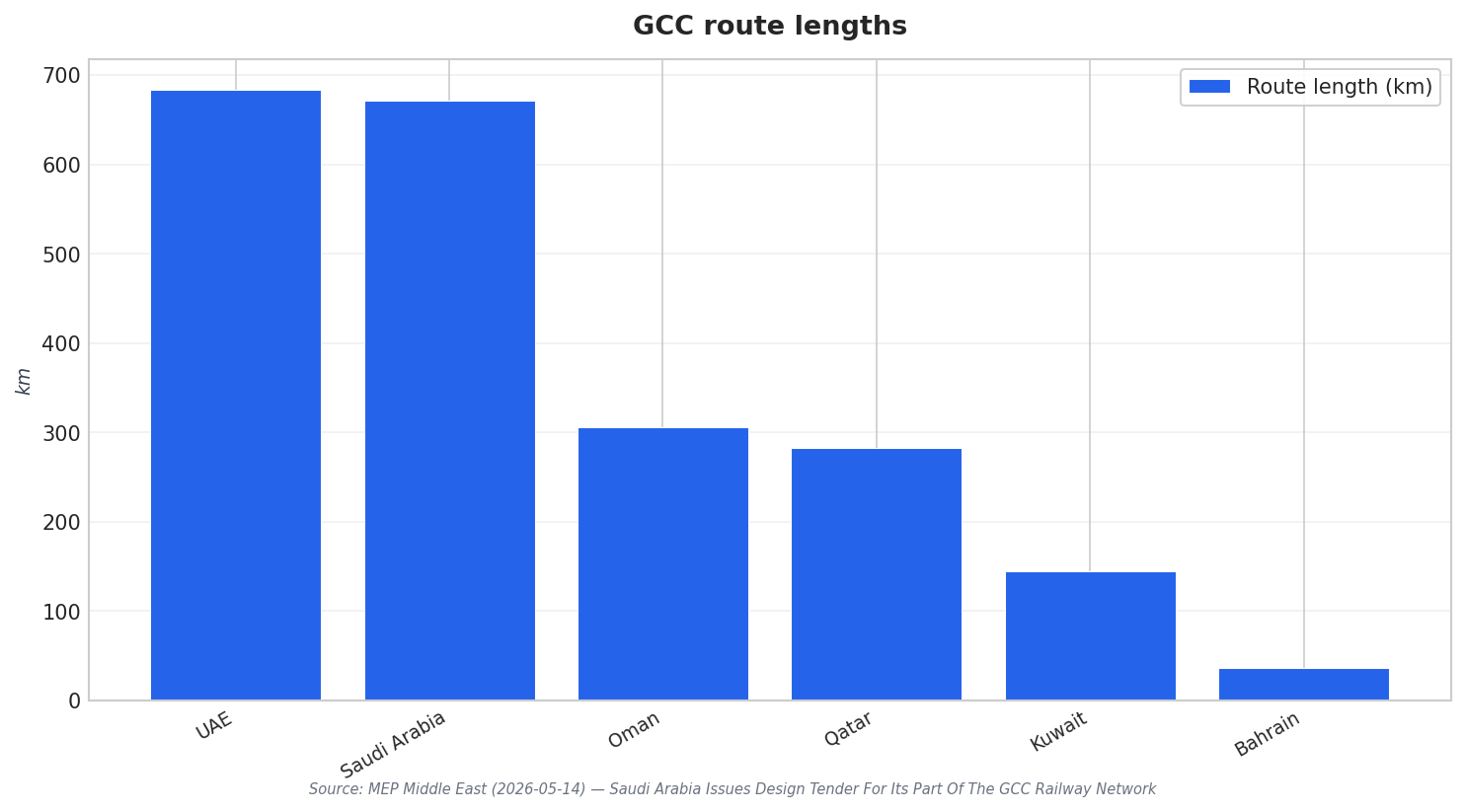
The regional context matters because the route length in each member state clarifies where future packages may concentrate. MEP Middle East and Zawya state the network’s route length within each member state as 684km in the UAE, 672km in Saudi Arabia, 306km in Oman, 283km in Qatar, 145km in Kuwait, and 36km in Bahrain. These figures show why the Saudi package is significant in scale alongside the UAE portion. For contractors, the design tender becomes a practical entry point into a multi-country program where each GCC state is responsible for implementing the portion of the project within its territory, as summarized by Wikipedia.
What makes the Saudi GCC railway design tender 2026 especially relevant for delivery teams is that it is not framed as greenfield design from scratch. Instead, SAR is explicitly asking the consultant to work with existing preliminary designs and bring them forward through to IFC design readiness. That often means tighter coordination across civil, systems, and constructability requirements so that design outputs can be used for subsequent contracting steps. It also heightens the importance of document control, design assurance, and clear interfaces—because the tender covers multiple phases rather than a single, standalone design milestone.
Regional activity provides additional signals about momentum. International Railway Journal reports that Hafeet Rail—the joint UAE-Oman company delivering a new 303km line from Abu Dhabi to Sohar in Oman—has reported the start of tracklaying. Time Out Dubai also states that, as of April 2026, the Hafeet Rail project is 40 percent completed. While these details relate to the UAE-Oman corridor rather than the Saudi section, they show that some GCC-linked rail delivery is moving beyond planning. For contractors assessing staffing and partnerships, that matters because it suggests parallel demand for rail expertise across the region as individual national segments progress at different speeds.
What does SAR’s 2026 design consultancy tender cover on the Saudi GCC Railway section?
How long is Saudi Arabia’s section of the GCC rail network in the tender?
What are the reported bid dates for the Saudi rail design tender?
Where does the Saudi segment run from and to?
How is the GCC route length split across member states?