Saudi Arabia is building the next phase of EV infrastructure, and speed matters. Many drivers and fleet managers worry about waiting to charge. Battery swapping offers a different path. Instead of plugging in, a vehicle exchanges a depleted battery for a charged one in a station. Research notes that conductive charging can take about an hour, while battery swapping can replace batteries in just a few seconds.
The regional market signals early momentum. An IndexBox report says the Middle East battery swapping charging infrastructure market is in an early commercial phase in 2026. It is driven mainly by fleet electrification mandates in the UAE and Saudi Arabia. The combined regional installed base is estimated at 120–180 swap stations. The same report says 2024–2025 had fewer than 50 operational stations region-wide, and 2026–2027 will see a 3x increase as fleets move from trial to committed rollout.
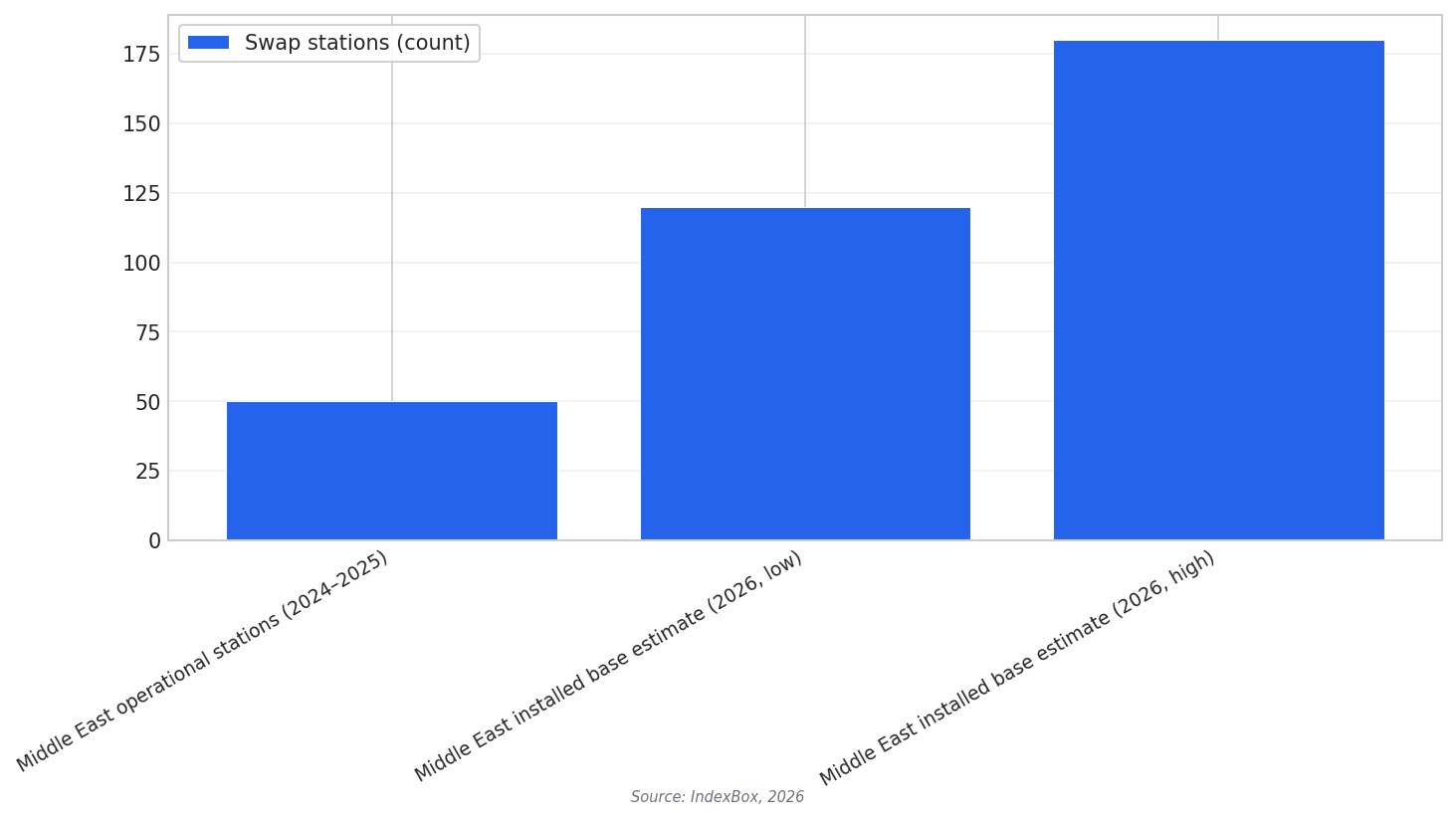
This chart uses Middle East totals, not Saudi-only station counts, because the sources provide a regional installed base range and a regional operational count for 2024–2025. Still, the same source directly links the 2026 regional push to mandates in the UAE and Saudi Arabia, so the direction is relevant for the Kingdom.
Why Swapping Fits Saudi Fleets and Cities
Saudi Arabia’s battery swap hardware market is described as unique in the Middle East. IndexBox links this to high vehicle utilization in taxi and delivery fleets, strong government commitment to EV adoption under Vision 2030, and a rapidly expanding renewable energy grid. In dense urban corridors such as Riyadh, swap demand is already tied to real use cases. IndexBox says light electric vehicles (2W/3W) account for about 55–65% of swap demand in 2026, concentrated in last-mile delivery fleets and ride-hailing operations in cities including Riyadh.
Business models are a major reason swapping can speed adoption. IndexBox reports that Battery-as-a-Service (BaaS) subscription models are emerging as the dominant commercial structure. It says BaaS can reduce upfront EV acquisition costs by 30–40% for fleet operators. The Saudi Arabia hardware report also says BaaS is gaining traction, shifting hardware procurement from vehicle OEMs to swap station operators and increasing demand for standardized, high-cycle-life packs and robotic handling systems.
But the rollout is not simple. IndexBox lists two major bottlenecks: grid connection approval timelines of 6–18 months and battery pack standardization. It also highlights capital intensity. CAPEX per swap bay ranges from USD 180,000 to USD 420,000 depending on automation level, and a single automated swap station can require USD 1.5–3.5 million. Import dependence is also high, with over 80% of station hardware, robotic components, and battery packs sourced from China, South Korea, and Europe, while local assembly initiatives are being evaluated in Saudi Arabia and the UAE.
What problem does a battery swapping station Saudi Arabia model solve?
How many battery swap stations exist in the Middle East today?
How can Battery-as-a-Service help EV adoption for fleets?
What are the biggest blockers to scaling battery swapping in the region?
How expensive is battery swap infrastructure to build?