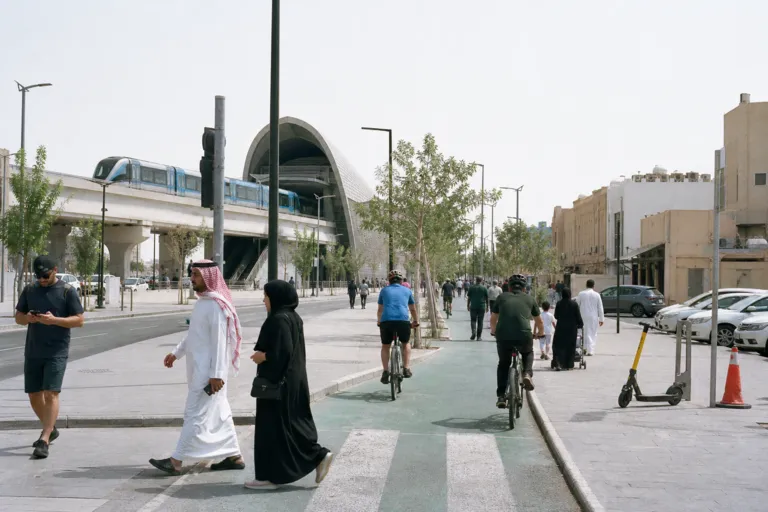
Sports Boulevard is positioned as Riyadh’s 135km active mobility spine and a statement about changing the city’s design priorities. The story matters because it links daily movement to public space, not just to road capacity. In the same city, a second major mobility reference point already exists: the Riyadh Metro. CNN described it as an automated rapid transit system launched in December 2024. It spans over 176 kilometers across six lines and links key points across the capital, including King Khalid International Airport and the King Abdullah Financial District (KAFD). Together, these projects sit inside a broader push to redefine mobility and reshape the capital’s image.
The keyword “Sports Boulevard Riyadh active mobility” is not just a slogan. It reflects a practical shift away from a car-only urban experience and toward choices that include walking and cycling as everyday options. A separate global context supports this direction. An AOL report, citing National Geographic, notes that car-free streets are popping up in cities around the world. It adds that cities are prioritizing pedestrians by expanding trails and bike lanes and by creating more sustainable green spaces and parks. This global pattern provides a useful lens for reading what Riyadh is building: a long corridor that can function as public realm, not just transportation right-of-way.
Why This Shift Signals the End of Car-Centric Urban Design
Car-centric design usually treats mobility as a problem solved by wider roads and longer drives. Riyadh’s current trajectory points in a different direction, blending transit access and place-making. CNN quoted Ibrahim bin Mohammed Al Sultan, Minister of State, Member of the Council of Ministers, and CEO of the Royal Commission for Riyadh City, saying the metro project will reshape the capital’s image and redefine mobility for residents and visitors. He also said the network is aligned with economic, social, environmental, and urban development objectives and represents a historic milestone in the capital’s transportation sector. In this setting, an active-mobility spine like Sports Boulevard fits a city narrative that is widening beyond the car.
Transit-oriented thinking is also appearing in real estate decisions, which affects how people move day to day. The Fintech Times reported on a Transit-Oriented Development (TOD) described as being just 250 meters from the Al-Takhassusi Metro Station. The project is designed to host a mix of hospitality, office, residential, and retail assets, and it aims to prioritize mobility and high-density living. Even though this is a single development example, it reinforces the same idea Sports Boulevard implies: location, proximity, and non-car access can shape urban life. When transit, dense destinations, and active-mobility corridors stack together, car dependence becomes less inevitable.
For the shift to last, infrastructure has to be used daily, not just admired. Consultancy-me.com argued that massive sports infrastructure investments will ultimately be judged by their legacy and whether facilities are used by communities, clubs, and the next generation of athletes. That idea connects directly to Sports Boulevard as an everyday spine rather than a one-off event venue. Riyadh’s wider cultural and civic direction also points to permanence. Artnet reported a shift from moment-based programming to sustained infrastructure, with art embedded in the city’s urban fabric rather than presented as temporary intervention. In that context, Sports Boulevard reads as long-term city-making: a move toward streets and corridors designed around people, not only cars.
What does “Sports Boulevard Riyadh active mobility” refer to?
How does the Riyadh Metro support a less car-centric city?
What is one example of transit-oriented planning mentioned alongside metro access?
Is Riyadh’s mobility change part of a wider global trend?
What determines whether these big urban investments succeed long term?