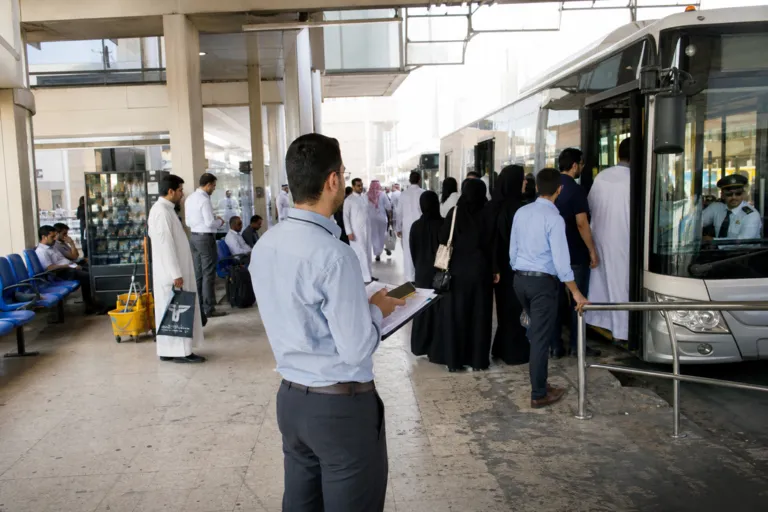
The headline claim of “30.6 million bus journeys in Q1 2026” cannot be verified from the supplied sources. None of the provided links contain a Saudi government release, operator report, or dataset that states 30.6 million bus journeys for Q1 2026. What the sources do show is the wider context around demand growth and infrastructure pressure across Saudi transport modes. That context matters when interpreting any modal shift narrative, because it signals where capacity is strained and where policy-aligned investment is being directed.
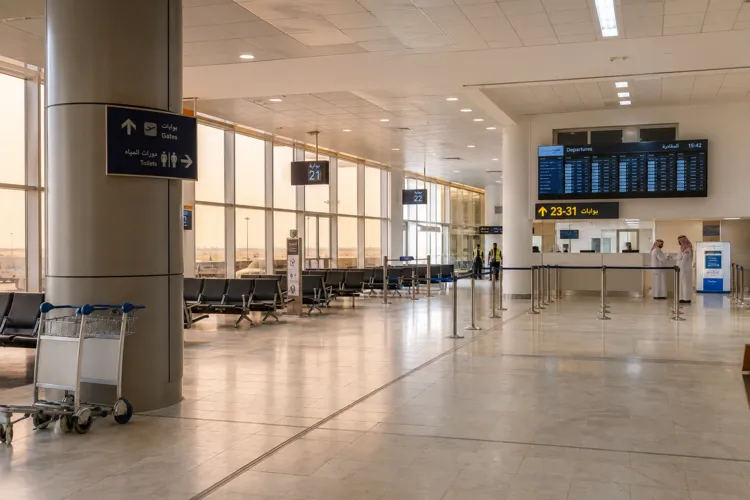
On the aviation side, Saudi Arabia ended 2025 with record passenger traffic of more than 140 million, which the General Authority of Civil Aviation described as a 9% increase from the previous year. International destinations were reported at 176. Airport-level pressure is also visible. King Abdulaziz International Airport in Jeddah handled 38% of all passengers and averaged 146,000 travelers per day, surpassing its designed capacity by 107%. King Khalid International Airport in Riyadh served 29% of passengers at 112,000 daily, while utilization rates were also cited at 137% for Medina and 112% for Dammam.
What the Available Numbers Suggest About Modal Shift Signals
If you are evaluating “Saudi public bus ridership Q1 2026,” the key limitation is simple: the sources here provide no Q1 2026 bus journey count, and they do not provide a comparable ridership series across quarters. However, there is one Q1 2026 datapoint that touches bus activity indirectly, in a financial disclosure about fuel cell products and services revenue by end-market. In the three months ended March 31, 2026, that segment reported bus revenue of $6.8 million, down 46% from Q1 2025. In the same table, rail revenue was $5.1 million, up 4472% year over year, while stationary revenue was $5.2 million, up 775%, and other markets were $2.4 million, up 6%.
These revenue figures are not ridership. They do not measure passenger journeys or boarding counts. Still, they can be read as an indicator that investment or sales momentum may be shifting between transit-related end-markets over the same Q1 window, with rail revenue expanding sharply while bus revenue fell in that specific segment. Because the source is a revenue breakdown, it is best used as a directional signal about supplier-side demand, not as proof of a passenger modal shift. Any conclusion about “30.6 million” bus journeys would require a separate ridership dataset that is not present here.
Forward-looking mobility changes are also implied by confirmed regional rail plans. Saudi Arabia has confirmed plans for a 785 km electric high-speed rail link with Qatar that would connect Riyadh and Doha with stops at King Khalid International Airport and Hamad International Airport. If completed on schedule, the two-hour journey is expected to begin operations by 2031. Qatar’s government estimates the route could carry more than 10 million passengers annually. If that estimate materializes, it would represent a structural new option in the Riyadh–Doha travel market and could shift how travelers choose between air and rail on that corridor.
Finally, the sources repeatedly frame transport expansion within Vision 2030. Saudi Arabia is preparing to host events including the AFC Asian Cup 2027, Expo 2030, and the FIFA World Cup 2034, and the aviation ecosystem is described as scaling infrastructure and services to handle inbound traffic. One aviation source also notes plans to add more than 150 new destinations by 2030 as part of a global connectivity strategy. In that environment, any “Saudi public bus ridership Q1 2026” story should be anchored in primary ridership reporting, and then interpreted alongside the clear evidence of aviation scale and the pipeline of major rail projects.
What does the keyword “Saudi public bus ridership Q1 2026” mean in this article?
Do the sources confirm 30.6 million bus journeys in Q1 2026?
What Q1 2026 bus-related number is in the sources?
What do the sources say about Saudi aviation demand pressure?
What rail data point could influence future modal shift?