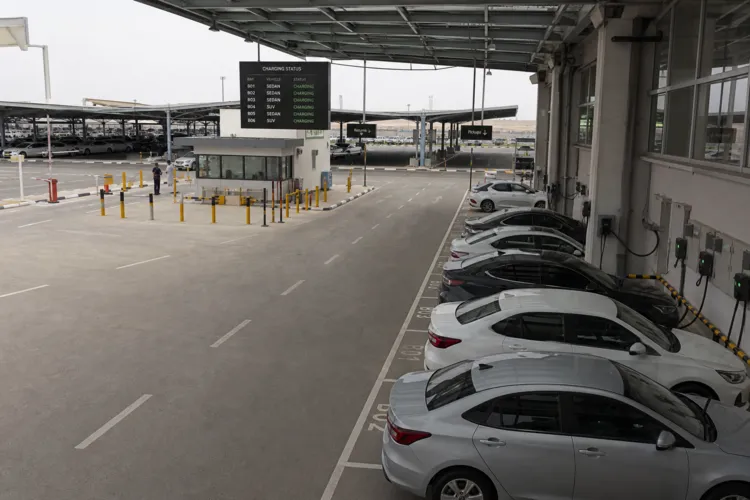
Saudi Arabia’s EV story is no longer only about sales growth. It is also about where vehicles and their most strategic parts are made. This is why the Saudi EV battery local content rule has become a practical topic for manufacturers, suppliers, and policymakers that want to translate demand into domestic industrial depth. Registration growth has been sharp. The Saudi Ministry of Investment data cited in one market report points to a 425% increase in EV registrations between 2021 and 2023, rising from 375 EVs in 2021 to over 12,000 by end-2023. In parallel, charging availability has expanded from 150 public stations in 2022 to over 1,000 by early 2024, reinforcing that adoption and localization are being developed together.
Local content becomes real when it is tied to supplier contracts, manufacturing footprints, and model launch timelines. In February 2025, Ceer signed SAR 5.5 billion (USD 1.4 billion) in supplier deals at the PIF Private Sector Forum, and the same source states this locked in 45% localization ahead of its 2026 model debut. Another industry source adds that local-content regulations endorsed at the 2025 Private Sector Forum are helping solidify supply-chain investments, supporting a shift away from import reliance. These statements do not only describe a brand strategy. They indicate how policy direction and procurement decisions can pull more battery-adjacent parts, processes, and quality systems into the Kingdom’s industrial planning.
What Ceer’s Supplier Deals Change for Battery Localization
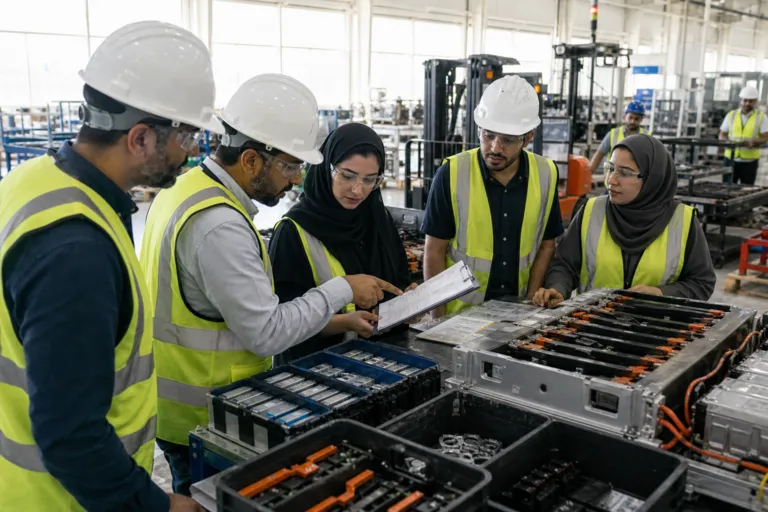
Ceer’s localization signal lands in a market where the bottleneck is widely described as the battery value chain itself. One forecast notes that in 2026 domestic production is less than 1% of sales, and that the supply chain for battery cells, modules, and power electronics remains entirely import-dependent. It also states that even as Ceer and Lucid ramp up, local content for battery packs, power electronics, and electric drivetrains will remain near zero for several years. Against that backdrop, supplier contracting matters because it can build the industrial “scaffolding” around batteries first, including pack integration readiness, thermal components, and related electronics that later enable deeper localization when upstream constraints ease.
Market projections suggest the opportunity is big enough to sustain these investments if execution follows. One battery-focused outlook cites IMARC Group research saying Saudi Arabia’s EV battery market reached USD 895.8 million in 2025 and is projected to reach USD 6,540.3 million by 2034, with a CAGR of 24.72% during 2026–2034. On the vehicle side, a separate IMARC-based view values the electric car market at USD 1.81 billion in 2025 and forecasts USD 5.52 billion by 2034, with a CAGR of 13.18% from 2026–2034. It also says battery electric vehicles held 57.9% share in 2025. Together, these figures frame why battery localization is treated as a cornerstone rather than a side project.
The timeline for localization still depends on how quickly local assembly becomes meaningful and how fast battery-related parts can follow. One market forecast says domestic production is expected to reach 20–30% of total market volume by 2030 and 40–50% by 2035, assuming Ceer and Lucid hit their targets. It also states that beyond these two, no other OEM had announced local assembly plans in Saudi Arabia as of 2026. Meanwhile, competition remains import-led. The same forecast says Chinese OEMs (BYD, MG, GAC, Neta) account for 40–45% of new Battery EV registrations in 2026, while European premium OEMs hold 15–20% combined. In that environment, Ceer’s supplier-led localization becomes a strategic lever to build domestic capability while the battery cell and module supply chain matures.
How is Saudi Arabia’s EV battery local-content policy shaping supply chains?
What did Ceer sign at the PIF Private Sector Forum?
How localized is Saudi EV battery hardware today, according to the forecasts cited?
What do the cited forecasts say about the Saudi EV battery market outlook?
When could domestic EV production become meaningful in Saudi Arabia?