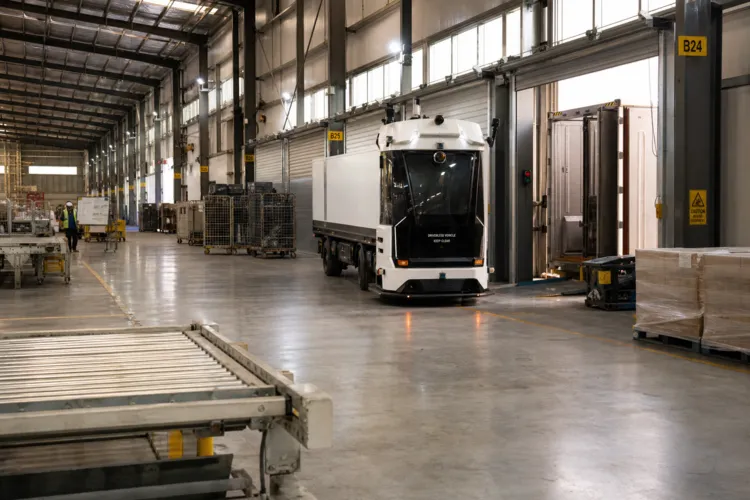
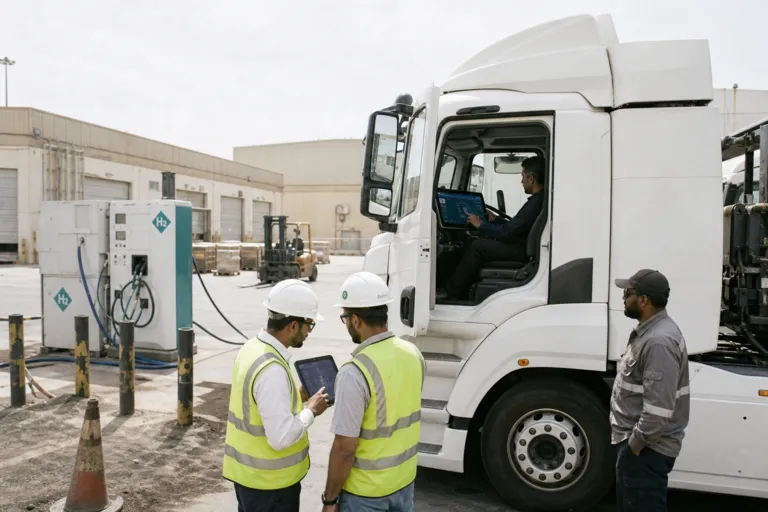
Saudi Arabia has launched what it describes as the Kingdom’s first hydrogen-powered heavy-duty truck fitted with autonomous driving technology. The project was unveiled with support from the Transport General Authority (TGA), alongside the Ministry of Energy and the Ministry of Transport and Logistics Services. It brings together Procter & Gamble (P&G), logistics company Ismail Abudawood, and technology firm Hyperview. In plain terms, this is not just a vehicle reveal. It is a live logistics pilot tied to national goals to modernise freight operations, reduce emissions, and build more resilient supply chains under Vision 2030.
The stated operating profile is built for long-haul realities. Multiple reports citing the TGA say the truck runs on clean hydrogen and produces zero tailpipe carbon emissions. They also report an operational range of up to 1,500 kilometres on a single fill, with refuelling possible “within minutes.” Those two claims are central to why the pilot matters for heavy transport. Long-distance routes are sensitive to downtime, and the pilot is framed as a way to keep utilisation high while cutting tailpipe emissions. Coverage also positions hydrogen as an option for routes that require extended range, rapid refuelling, and heavy payload capability.
What the Autonomy Stack Suggests About Near-Term Deployment
The autonomy angle is described as multi-level autonomous driving, enabled by advanced software, artificial intelligence, and digital systems that allow continuous updates. Saudi authorities say these technologies are intended to improve operational efficiency, strengthen supply chains, and enhance road safety. Other reporting characterises the system as “Level 4-capable,” while also pointing to earlier Hyperview work with Aramco that used a Level 3 system for route planning, lane-keeping, and obstacle detection. Taken together, the message is that the pilot is focused on freight productivity and safety outcomes, not just a headline-grabbing claim about removing drivers.
For P&G, the partnership is positioned as a direct test of what zero-emission freight can look like in a real consumer-goods supply chain. Hydrogen Fuel News notes that P&G teams up with Ismail Abudawood Group to manage manufacturing, distribution, and storage of household and personal care products in Saudi Arabia, and that the trial gives P&G first-hand insights into how hydrogen-powered autonomous trucks affect logistics costs and practicality. The same outlet adds a key “watch” point: if results show total ownership costs are favourable compared to diesel, authorities may accelerate long-term licensing for hydrogen autonomous fleets, and investors could take the signal to expand hydrogen infrastructure.
As a marker of momentum, the Saudi autonomous hydrogen truck pilot also stands out in contrast to debate elsewhere. One report describes U.S. momentum for fuel-cell trucks as having “largely stalled” after Nikola and Hyzon left the field, even as Toyota, Daimler, and Volvo remain involved. Against that backdrop, Saudi Arabia has put an autonomous hydrogen heavy truck onto the road with an anchor shipper named in the project, and a stated range figure repeated across regional and international coverage. For clean long-haul logistics, the signal is less about a single truck and more about a coordinated test: regulator support, a freight owner, an in-country logistics partner, and an autonomy technology supplier moving together.
What is Saudi Arabia’s autonomous hydrogen freight truck pilot with P&G and Hyperview?
What range and refuelling claims are reported for the truck?
Which Saudi entities are linked to supporting the launch?
What autonomy capabilities are described in the coverage?