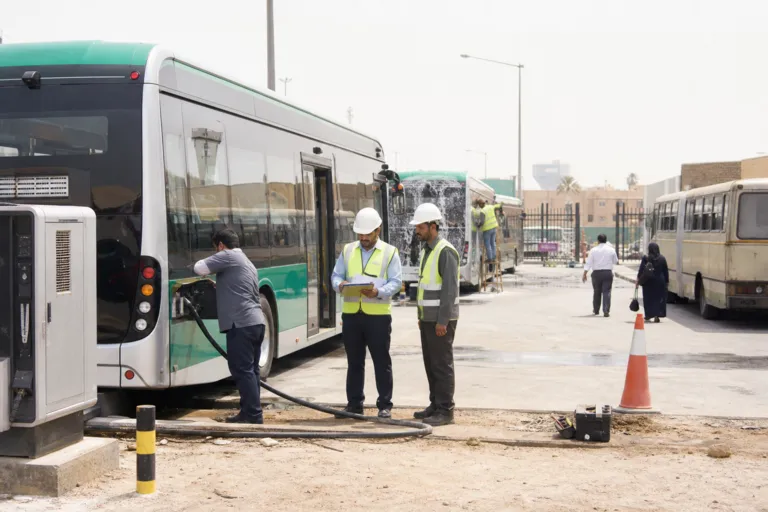
SAPTCO’s 1,500-bus order, including 300 electric buses, is positioned to reshape daily public transport in Riyadh and Jeddah. The move matters because it links fleet renewal with electrification at meaningful scale, rather than treating electric buses as a limited pilot. The key question for riders and planners is not whether electric buses can work, but what kinds of results they deliver when deployed on real routes and evaluated by users. The most relevant signal in the sources is that operating outcomes can be measured in satisfaction and emissions, not only in vehicle counts.
Operational performance is one of the strongest arguments for an electric shift. In Dubai, the same transit authority currently has about 40 electric buses operating, and the reported results were described as a success. The operational results showed a clear superiority of electric buses, especially on short and medium-term urban trips. The satisfaction rate exceeded 95% among drivers and passengers. This type of feedback loop is important for any growing network, because it connects vehicle technology to the rider experience and the day-to-day reality of operating a busy city fleet.
Environmental impact is also framed in concrete terms in the sources. Using all-electric buses in Dubai supported decarbonization by preventing the release of 59,263 tons of carbon dioxide emissions during 2025. While that figure is specific to Dubai’s context and is not a stated estimate for SAPTCO, it shows how some agencies quantify the impact of replacing diesel service with all-electric operation. For Riyadh and Jeddah, SAPTCO’s electric-bus tranche creates a clear pathway to track similar outcomes over time using the same kinds of operational metrics.
How Global Electric Bus Momentum Frames SAPTCO’s Next Step
The global backdrop shows electrification moving beyond isolated announcements. Senegal now has 121 electric buses running on clean, renewable electricity, described as fully electric buses rather than hybrids. Australia, by contrast, is still early in adoption: electric buses are just 1% of the Australian fleet, compared with 80% in urban China, a quarter in the Netherlands, and 12% in the UK. These comparisons highlight that fleet electrification can move quickly in some places and slowly in others. In that context, SAPTCO’s scale signals intent to move faster than a cautious, small-batch approach.
Fleet conversion also depends on procurement reality and operational design. In Denmark, a contract for 50 articulated electric buses specifies batteries with a total capacity exceeding 700 kWh, enabling continuous operation throughout the day without intermediate charging. Elsewhere, cost pressures can be explicit: in Malaysia, electric buses were cited as costing between RM1.2 million and RM1.5 million per unit, nearly double diesel alternatives, with procurement emphasizing lifecycle value rather than upfront cost. The lesson for a large urban program is that electric-bus success is often tied to how vehicles are specified, charged, and justified operationally, not merely purchased.
For the SAPTCO electric bus fleet Saudi Arabia story, the headline is the combined scale of the overall 1,500-bus order and the 300 electric buses within it, aimed at urban reshaping in Riyadh and Jeddah. The sources do not provide SAPTCO’s delivery schedule, routes, charging approach, or performance targets, so the most responsible interpretation is directional: global agencies are already reporting measurable rider satisfaction above 95% in city operation, and quantified CO2 avoidance such as 59,263 tons in a single year in one example market. Those are the types of benchmarks that can define what “reshaping transit” ultimately means in practice.
What does the keyword “SAPTCO electric bus fleet Saudi Arabia” refer to in this article?
What operational results have electric buses shown in the sources?
Do the sources quantify emissions benefits from electric buses?
How does electric bus adoption vary internationally in the sources?
What cost context for electric buses appears in the sources?