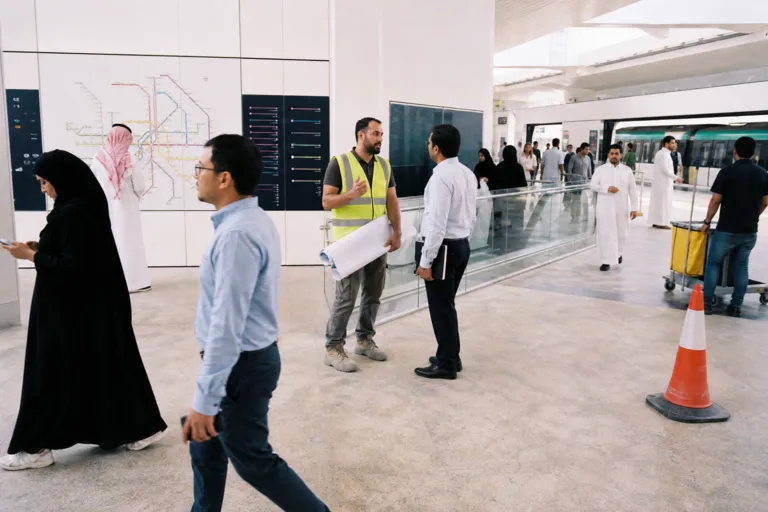
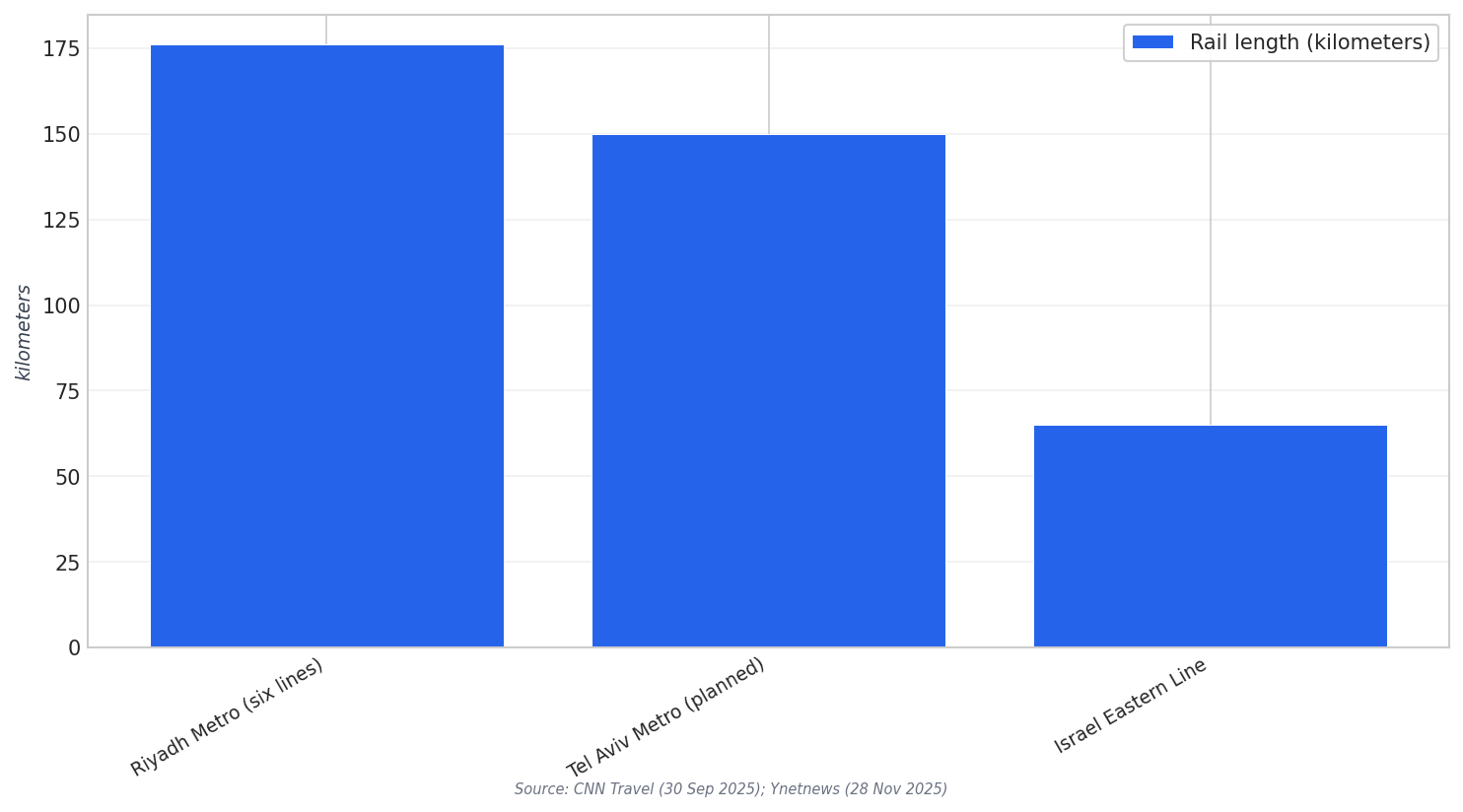
Riyadh’s metro story changed pace in December 2024. The Riyadh Metro launched then as an automated rapid transit system. According to CNN, it spans over 176 kilometers across six different lines. The network links key points across the capital, including King Khalid International Airport and the King Abdullah Financial District (KAFD). The same report describes it as the world’s longest driverless metro system. It was built at a cost of $22.5-billion and is designed to carry at least 3.6 million passengers a day. In that context, the Riyadh Metro Line 7 expansion discussion is about scaling a system that already targets very high daily capacity.
The platform for any expansion is also physical and visible. CNN reports the metro has a total of 85 stations. Four are highlighted as standouts: King Abdullah Financial District (KAFD), STC, Western Station and Qasr Al Hokm. KAFD was designed by Zaha Hadid Architects. Qasr Al Hokm was designed by Norwegian architectural firm Snøhetta in collaboration with ONEWORKS + CREW. It officially opened in February 2025 and provides direct access to government buildings and landmarks, including Al-Hukm Palace, Imam Turki bin Abdullah Grand Mosque and Al Masmak Palace. These station anchors help explain why new links matter as destinations multiply.
Early changes also show the system is not static. CNN notes that in September, Hassan bin Thabet Street Station was added to the Orange Line. That single update signals active network tuning after launch. It also supports the idea that the next phase can be packaged as a distinct new corridor. This is where Riyadh Metro Line 7 expansion enters the conversation, not as a brand-new concept, but as a continuation of a living network. Expansion planning becomes easier to justify when the baseline system already has major nodes, high ridership capacity targets, and a continuing pattern of station additions.
Line 7 as the Next Capacity Wave
CNN says the metro’s early success has already spurred expansion plans. A proposed seventh line will connect Qiddiya Entertainment City, King Abdullah International Gardens and Diriyah Gate. This proposed connectivity matters because it links leisure, cultural, and destination-scale developments into the same rapid transit logic that already serves the airport and KAFD. Separately, MEED reports a Qiddiya High-Speed Rail Project that involves developing a high-speed railway line connecting King Salman International airport and King Abdullah Financial District with Qiddiya City. Read together, the sources show Qiddiya is being positioned for strong rail access, with the proposed seventh metro line adding an urban-capacity layer around those connections.
Diriyah’s growth provides another reason to focus on new transit capacity. Global Construction Review reports that Parsons received a $56m five-year contract for design and construction supervision tied to Diriyah’s next phase. The scope includes the design and delivery of iconic parks, open spaces, and more than 55km of streetscapes, plus streets, footpaths, civic buildings and other public-realm assets. A proposed Line 7 connection to Diriyah Gate, as reported by CNN, aligns with a place that is actively expanding its public realm. That pairing frames Riyadh Metro Line 7 expansion as a capacity and access response to rising trip demand around major development zones.
Riyadh’s transit buildout also sits inside a wider regional narrative of capacity-focused metro planning. Newsweek reports Dubai’s planned Blue Line will feature International City (1), described as the largest underground interchange station in the metro network, covering over 44,000 square meters and with capacity to handle 350,000 passengers daily. This is not Riyadh data, but it signals the scale of passenger handling that Gulf metro projects are designed around. Riyadh’s system, per CNN, is already designed for at least 3.6 million passengers a day. In that environment, a proposed seventh line is best understood as the next wave of capital transit capacity, adding new destinations while reinforcing a high-throughput network model.
What is the Riyadh Metro Line 7 expansion expected to connect?
How large is the Riyadh Metro network today?
What passenger capacity is Riyadh Metro designed for?
Which stations does CNN highlight as standout stations?
What other rail project also targets a connection to Qiddiya City?