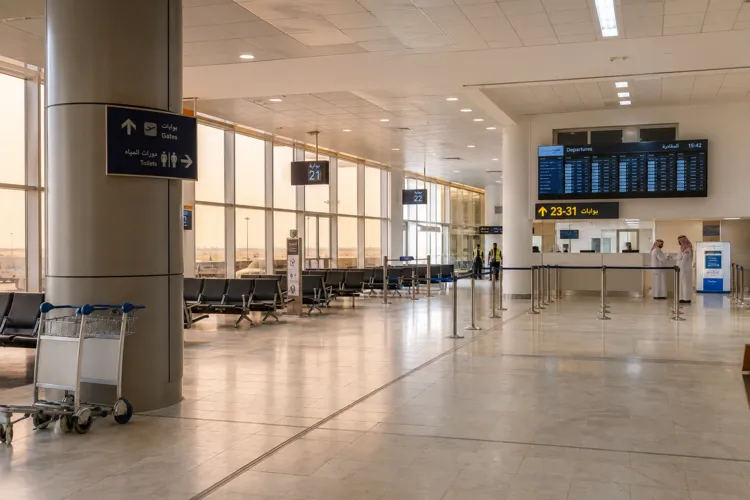
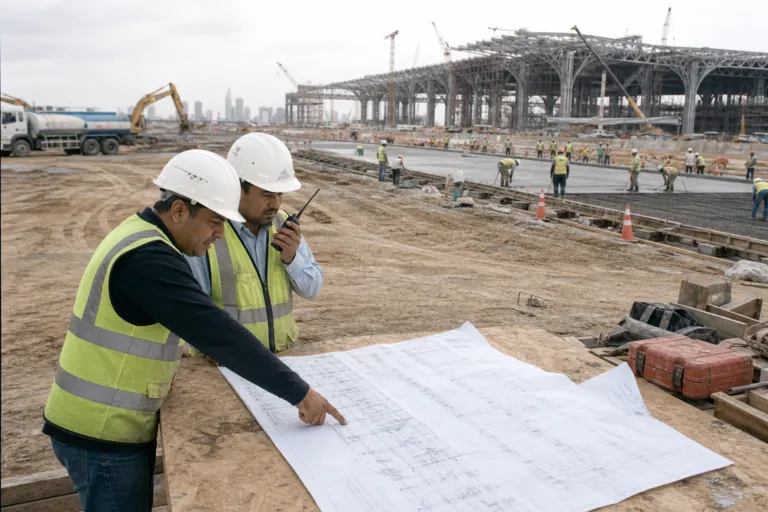
King Salman International Airport (KSIA) is being developed on the existing site of King Khalid International Airport in Riyadh. Plans described across official and industry reporting include integrating the current King Khalid terminals alongside three new terminals, plus residential, leisure, and logistics facilities. The full development is stated at about 57 square kilometres, with a master plan designed to include six runways. The airport’s development is positioned as part of the Kingdom’s wider aviation and economic development agenda under Saudi Vision 2030, with construction activity now visibly concentrated on airside execution and enabling works.
A major marker for King Salman International Airport construction in 2026 is the third runway breaking ground in January 2026, described as a strategic step to improve operational readiness and support long-term growth in air traffic demand. Multiple sources state the runway will be 4,200 metres long and will incorporate multiple access taxiways to support smooth aircraft flow on the ground. The runway design is also described as aligning with prevailing wind conditions in Riyadh to maintain safe and efficient aircraft operations across operating scenarios. Delivery is being carried out in partnership with FCC Construcción SA and Al-Mabani General Contractors Company.
Third Runway Capacity Lift and the Packages Surrounding It
Airside capacity improvements are being quantified alongside the runway works. The airport’s current operational capacity is cited at around 65 aircraft movements per hour, with the addition of the third runway and associated enhancements expected to increase this to approximately 85 movements per hour; this same “65 to nearly 85” uplift is repeated in construction trade reporting. Contractors have mobilized for runway, taxiway, and utility packages, while preliminary site preparation continues across multiple sections of the master plan. Riyadh-based contractor Binyah is also reported to have secured framework agreements covering earthworks, road diversions, and utility relocation activities, indicating continued demand for enabling infrastructure capabilities.
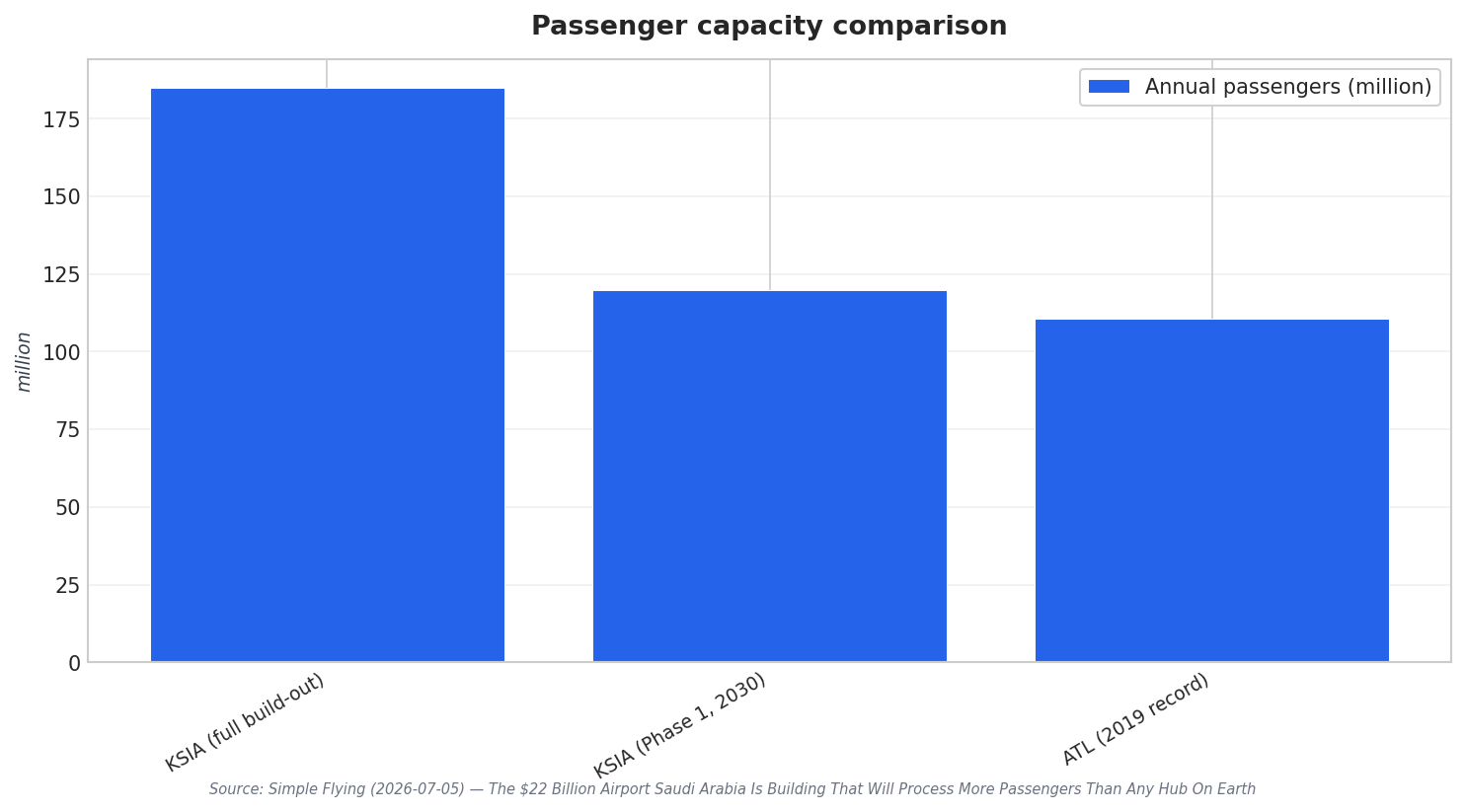
On the demand side, KSIA is described with multiple capacity targets by 2030 across the sources. Several reports state the airport is designed to accommodate up to 100 million passengers annually and handle more than two million tonnes of cargo by 2030. Separate reporting also states that, by 2030, the airport’s first phase is designed to process 120 million passengers annually. Longer-term ambition is described even more expansively: one source states a plan to handle 185 million passengers a year, and also cites an all-time annual passenger record of 110.5 million set by Hartsfield-Jackson Atlanta International Airport in 2019 as a benchmark comparison.
Beyond airside works, procurement is actively moving on terminal development. Construction reporting says procurement continues for Terminal 6 and the airport’s Iconic Terminal packages, with several international consortiums entering early contractor involvement stages. Named teams include United Contractors Company (UCC) and Consolidated Contractors Company (CCC); Al-Gihaz Holding with TAV Construction and Webuild; and PowerChina with Mohammed Alsubeaei & Sons Investment Company (MASIC) Building Line Division (MBL). Additional tendering is also cited for fuel storage facilities, hydrant systems, and further runway infrastructure. Separately, Bechtel, Parsons, and Mace are reported as already contracted, reinforcing that the delivery program is being structured across multiple major workstreams.
What is happening in King Salman International Airport construction during 2026?
How long is the third runway, and what is it designed to improve?
Which contractors are delivering the third runway package?
What operational capacity change is expected with the third runway?
Where are contractor opportunities emerging beyond the runway works?