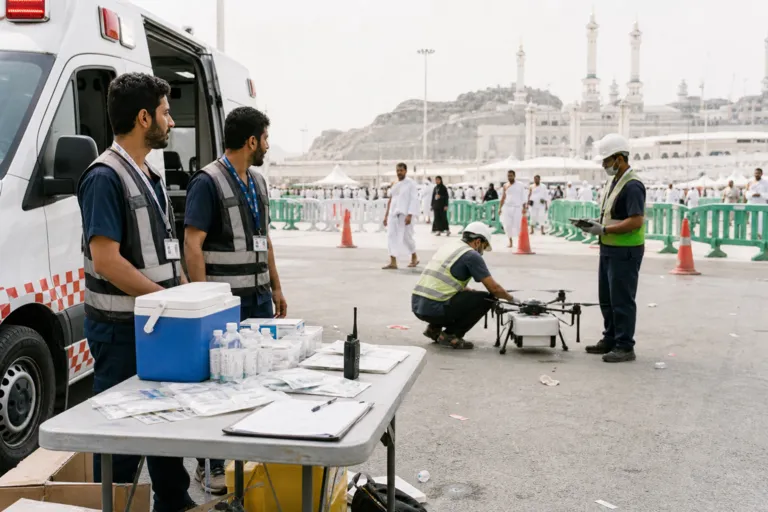
Saudi Arabia’s General Authority of Civil Aviation (GACA) has issued its first operational permit for limited drone-based delivery of medicines and medical logistics to Terra Drone Arabia within the holy sites in Makkah during the 1447 AH Hajj season. Saudi Press Agency (SPA) framed the decision as part of a commitment to adopting advanced technologies in the service of pilgrims. Multiple reports also describe the permit as the first of its kind, focused specifically on medicine delivery and medical logistics in one of the most operationally sensitive environments in the Kingdom.
According to coverage carried by Zawya, the permit is designed to support GACA’s efforts to advance the aviation sector, localize innovative solutions, and improve operational efficiency and response speed for medical and logistics services under the highest safety and quality standards. Gulf News added that the authorization allows drone operations within the holy sites under regulatory and operational frameworks intended to meet safety, quality, and efficiency requirements. Together, these points define the intent behind the newly approved operating model: limited medical logistics flights, governed by specific frameworks, and aimed at faster service delivery in the Hajj setting.
From Last Season’s Trials to a First-of-Its-Kind Permit
The Hajj drone medical delivery permit did not emerge in isolation. GACA and other reports say the move builds on pilot operations conducted during the previous Hajj season, when drones were tested for medical supply and logistics services across the pilgrimage areas. EplaneAI described these prior trials as informing new regulatory and operational frameworks that helped enable this first permit. New Arab quoted GACA describing the step as a continuation of those earlier operational trials, while also emphasizing that operations are conducted according to the highest standards of safety, quality, and operational efficiency.
New Arab also highlighted a concrete operational promise tied to the drone concept in this setting: it said an aerial drone will be able to reduce the time it takes for necessities to reach pilgrims from over an hour to just minutes. In the same report, GACA’s permit was described as covering delivery of necessities such as water and medicine during this year’s pilgrimage. This time-compression claim matters most in medical logistics, where the gap between “over an hour” and “minutes” can reshape how quickly supplies move within crowded holy sites.
The permit arrives in the context of Hajj as a major mass-gathering event. New Arab described it as one of the largest mass gatherings of human beings in the world, drawing up to 2.5 million pilgrims annually, and reported that the 2026 pilgrimage began with an estimated 1.5 million worshippers. Other reporting pointed to a broader push to integrate artificial intelligence, automation, and drone technology into Hajj operations to improve healthcare delivery and logistics. Within that wider modernization track, GACA’s limited authorization for Terra Drone Arabia is positioned as a regulated, safety-focused step toward faster medical support where it is most needed.
What did GACA approve for Terra Drone Arabia during Hajj 1447 AH?
How does the Hajj drone medical delivery permit build on earlier work?
What operational impact did GACA-linked reporting claim drones could have on delivery time?
What standards did GACA emphasize for drone operations at the holy sites?
How large is Hajj, based on the reported figures in the sources?