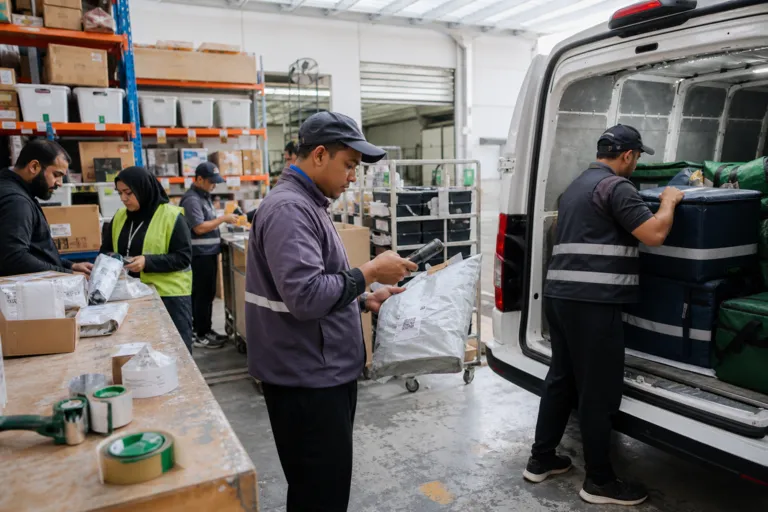
“118 Million Orders in Q1 2026” captures the scale of demand pressure that last-mile operators in the Kingdom must plan for, even as consumer expectations keep tightening. The Saudi last-mile delivery market 2026 conversation is increasingly shaped by quick commerce, where ultra-fast delivery is no longer treated as a bonus. Research cited by Consultancy-me describes how this convenience shifted from a pandemic-era luxury into a standard expectation in Saudi Arabia. That expectation forces networks to win on speed, density, and reliability across the highest-demand urban corridors.
Maven Insights research, reported by Consultancy-me, points to a digital-first environment that supports rapid delivery models. The same source highlights near-universal connectivity, a highly urbanized population, a young consumer base, and a digitalized payment ecosystem. It also quantifies adoption: 34% of the population are active users of quick commerce services, while 66% have yet to adopt. That split matters for last-mile planning because it signals both current volume and headroom. Operators can build capacity around existing demand while positioning coverage and service design for the non-adopter majority.
Why Quick Commerce Behavior Rewrites Last-Mile Economics
Quick commerce usage patterns reveal why delivery fleets and micro-fulfillment strategies keep expanding. Consultancy-me reports that around 70% of users place orders because they need an item urgently, while 60% do so for general convenience. These motivations reinforce time sensitivity, which pushes last-mile delivery to optimize dispatching, rider utilization, and inventory proximity. Basket composition also signals what moves most often: snacks and beverages appear in 51% of baskets, while groceries appear in 47%. These frequent, everyday items translate into repeat delivery cycles that reward networks built for high-frequency, short-distance drops.
Infrastructure and technology investment also adds momentum to last-mile capabilities. DHL cited investing more than EUR 500 million in the Middle East, driven by the region’s growing strategic importance in global trade, with GCC countries including Saudi Arabia positioned as logistics and innovation hubs. In parallel, FedEx highlighted the launch of its FedEx Import Tool (FiT) in Saudi Arabia. The Fintech Times describes FiT as a digital platform designed to simplify imports by providing real-time visibility and centralized documentation, helping enable faster customs clearance. Faster clearance supports the broader supply chain that feeds domestic distribution and last-mile execution.
Saudi Arabia’s digital baseline supports the operational shift toward data-driven delivery. TS2.tech reports roughly 99% internet penetration, with the digital economy already at around 15% of GDP and growing about 11% year-on-year in 2024. Those conditions make it easier for platforms to drive app-based ordering, routing optimization, and payment reliability. The policy backdrop reinforces this direction. PropNewsTime notes alignment with Vision 2030 and the National Transport and Logistics Strategy, with a goal to make the Kingdom a global logistics hub supported by digital transformation and advanced infrastructure.
For stakeholders tracking the Saudi last-mile delivery market 2026, the opportunity sits at the intersection of adoption headroom and urgency-led purchasing. Active usage at 34% implies a large untapped segment at 66%, while existing users are ordering for urgent needs at 70% and for convenience at 60%, according to Consultancy-me. That combination rewards companies that can scale capacity without breaking service quality. It also favors players who invest in digital tools that reduce friction across the end-to-end flow, from import processes to final doorstep execution, because speed expectations are now embedded in everyday purchasing habits.
What is driving demand in the Saudi last-mile delivery market 2026?
How much of the population is using quick commerce services in Saudi Arabia?
What do Saudi quick commerce customers buy most often for delivery?
What logistics investments or tools are being highlighted in the region and Saudi Arabia?
Which digital conditions support ultra-fast delivery models in Saudi Arabia?