
Issues
The city was dominated by private vehicles with low uptake of public transport and minimal shared mobility services. There was limited infrastructure for pedestrians, cyclists, or e-scooter users. Public transport routes were disconnected from residential neighborhoods. Parking inefficiencies, unregulated curb usage, and a lack of data transparency further worsened traffic and emissions. Citizens had low awareness of alternatives to private vehicles, leading to increasing urban sprawl and environmental costs.
Solution
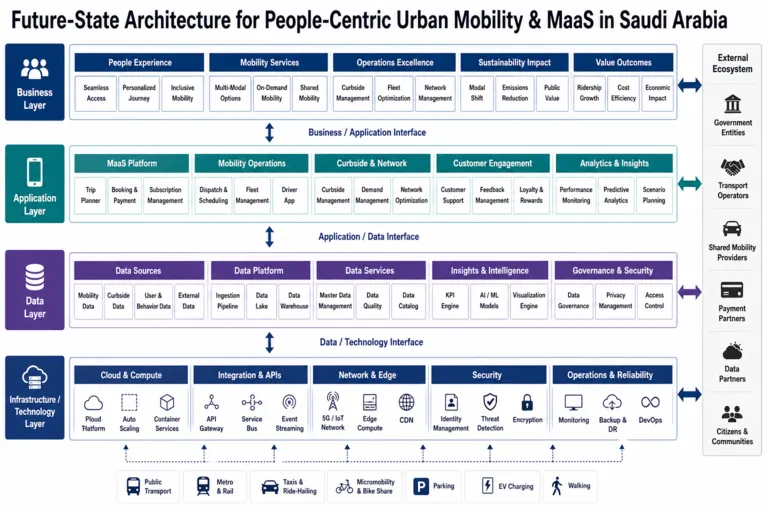
We co-created a dynamic urban mobility plan centered on accessibility, inclusiveness, and modal shift. It integrated public transit with ride-sharing, introduced micro-mobility zones, and piloted a city-owned mobility-as-a-service (MaaS) platform. Key interventions included curbside reallocation, pedestrian-priority areas, and smart parking technologies. Through digital integration and urban design updates, the city repositioned mobility as a service, rather than as car ownership.
Approach
Assessed transport behavior using mobile location data and urban density analysis
- Mapped first-mile and last-mile gaps in public transit routes
- Launched pilot zones for shared e-scooters and e-bike lanes
- Developed a MaaS app integrating bus, taxi, ride-hail, and micromobility
- Introduced smart parking sensors and dynamic pricing for curb usage
- Partnered with private operators for shared mobility fleet deployment
- Developed non-motorized mobility plan to enhance walkability
Recommendations
Expand smart parking and congestion pricing to manage peak traffic flow
- Design shaded, accessible pedestrian routes around public transport stops
- Enforce urban regulations for curbside usage to support pick-up/drop-off
- Incentivize shared mobility usage through loyalty and green commute credits
- Set up centralized data exchange platform for all mobility providers
- Include real-time MaaS data in city traffic control center operations
Engagement ROI
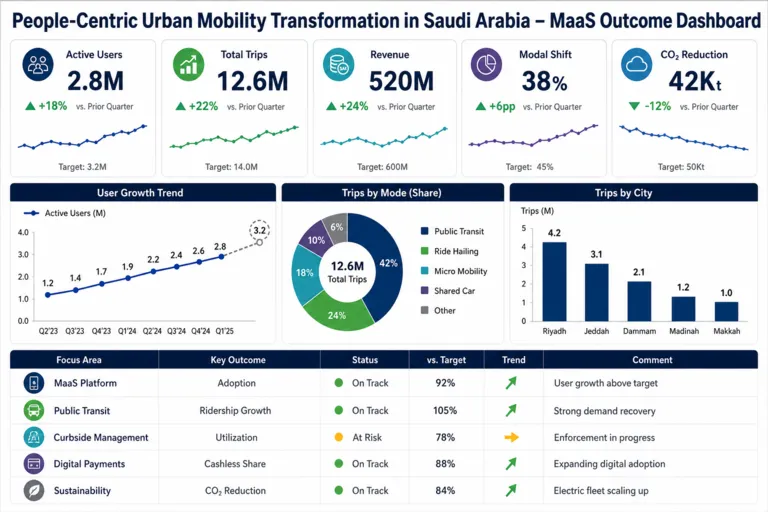
Private vehicle usage decreased by 16% in the core CBD, while shared mobility usage increased by 2.1x in the first 6 months. The MaaS app was downloaded by over 95,000 users, reducing average door-to-door commute time by 12 minutes. Smart parking sensors improved space utilization by 37%, and curbside conflicts declined by 48%. Carbon emissions from personal vehicle trips dropped by an estimated 3,800 tons CO₂/year.