
Issues
- Mass transit network fragmented, inefficient, underutilized.
- Bus services lacked route optimization; irregular frequencies; low punctuality.
- Poor coordination between transport modes limited seamless journeys.
- Key areas underserved, especially during peak hours.
- No digital ticketing, real-time tracking, or journey planning tools.
- High car dependency led to emissions and congestion.
Solution
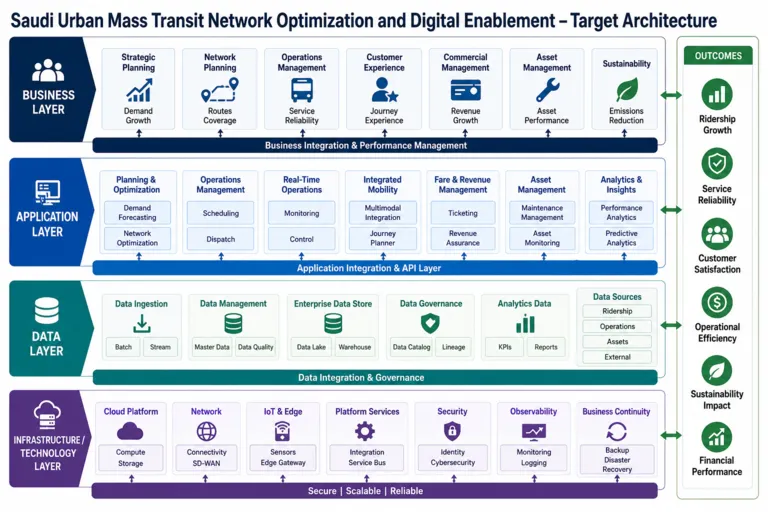
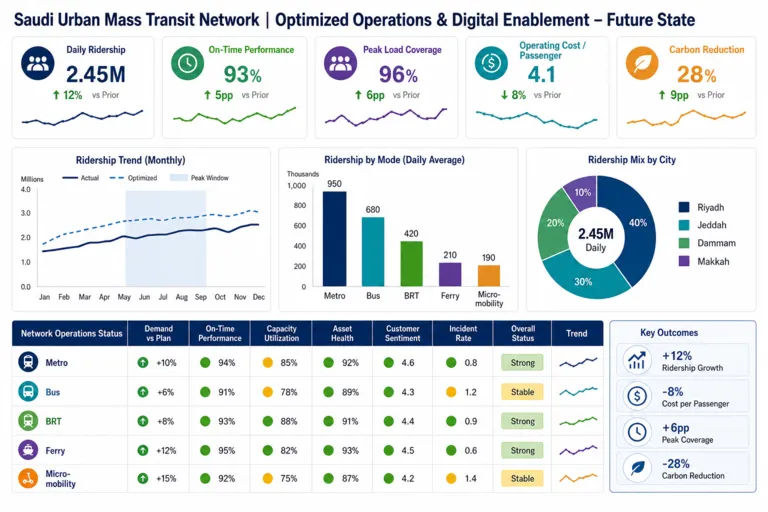
Delivered comprehensive urban mass transit optimization plan: improved service frequency, route efficiency, last-mile coverage; introduced multimodal integration (feeder buses, BRT lines, micro-mobility partnerships); embedded digital ticketing, passenger information systems, GPS-based fleet tracking; restructured service schedules/routes based on peak demand; implemented real-time dashboards for ridership & KPIs; aligned with environmental goals and scalable for other cities.
More details: Project Link
Approach
- Conducted citywide transport diagnostics, including underserved area heatmaps.
- Analyzed transit demand and peak-hour congestion via mobile GPS datasets.
- Designed integrated BRT and feeder network for city core and outskirts.
- Proposed phased rollout of digital ticketing & journey planner app.
- Developed KPIs for wait times, route coverage, and user satisfaction.
- Introduced real-time fleet tracking linked to central operations.
- Delivered staff training modules for performance management and system maintenance.
Recommendations
- Expand feeder network to industrial & low-income residential zones.
- Introduce smart card & mobile payment systems across all modes.
- Promote BRT expansion with dedicated lanes to reduce delays.
- Partner with private micromobility providers for last-mile e-scooter coverage.
- Monitor ridership weekly and dynamically reallocate buses as needed.
- Conduct awareness campaigns on mass transit benefits and safety standards.
Engagement ROI
The mass transit optimization project led to higher ridership, reduced congestion, improved commuter experience, and lower environmental impact. Cities achieved more efficient service delivery, digital integration, and scalable transit solutions, supporting sustainable urban mobility goals.